Oracle Audio Delphi Mk VII Classic Turntable
Need advice? Want a price match?
Talk to Mike
Third-generation owner
Call or text: 410-239-2020Yes, that's literally his cell
Mike's Take
Mike's Take
Family-Owned Authorized Dealer
Family-Owned Authorized Dealer
We're an authorized dealer for every brand listed on this site, so your warranty is valid and fully supported. We're a real brick-and-mortar shop in Chestertown, MD with shelves of actual inventory, not a drop-shipper. Family-owned and run for three generations, since 1978.
Delivery and Shipping
Delivery and Shipping
Free shipping for most items over $100! Local delivery up to 500 miles more with minimum qualifying purchase.
See our shipping policies for details. We will contact you after your order.
Custom Orders Welcome
Custom Orders Welcome

Oracle Audio Delphi Mk VII Classic Turntable
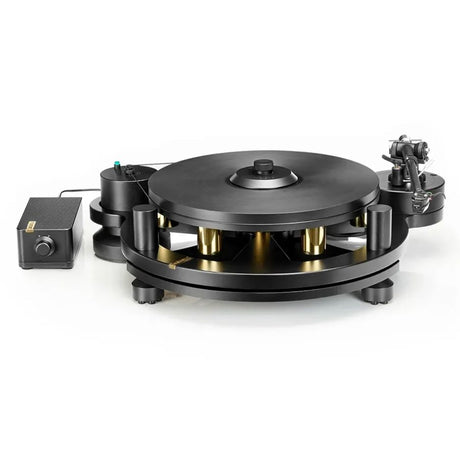
The Oracle Audio Delphi MkVII Classic is the seventh generation of the suspended turntable Oracle introduced in 1980, and the Delphi you can watch float: a hand-brushed aluminum sub-chassis on three spring towers over a clear acrylic base. Oracle's Micro Vibration Stabilizer System, a six-screw dual tripod bearing and a 4 kg two-piece platter sit on top, driven from the regular power supply or the Turbo MkII.
The Classic is the Delphi Oracle documents in full, and the other two MkVII models build on it: the Delphi MkVII Reference moves it onto a granite base, and the Delphi MkVII Signature lights it from within. Tonearm and cartridge are your choice, and Oracle's pre-cut arm board takes almost any 9-inch arm.
Key Features of the Oracle Audio Delphi MkVII Classic Turntable
- Micro Vibration Stabilizer System (MVSS): Tapered plungers under the sub-chassis sit in silicone reservoirs beside each suspension tower, damping micro vibrations inside the floating sub-chassis without short-circuiting the suspension. Oracle calls it the single most significant improvement to its turntable since 1979.
- Dual Tripod Bearing: Six precision PEEK screws, three at the top and three at the bottom offset 60 degrees, center the spindle. Its tungsten carbide ball tip rides on a Glass Filled Torlon thrust plate, with no metal-on-metal contact.
- Two-Piece Platter Assembly: The belt goes on the light inner platter hub before the main platter ring is lowered on top, so the bearing calibration is never disturbed, and the coupling reduces platter resonances.
- 4 kg Machined Platter: Solid 6061T6 aluminum-magnesium alloy with a diamond-cut finish, its mass concentrated at the outer edge for flywheel effect.
- Tri-Pedal Suspension: Three towers, each combining 12 components and 7 mechanical filters, carry the sub-chassis, platter and tonearm.
- Expanded Sub-Chassis: 3.9 kg of hand-brushed, clear-lacquered aluminum in a skeletal design, with the tonearm mounting ring support widened by about 35 percent.
- Factory-Calibrated AC Synchronous Motor: Low-voltage motor with impedance-matched coils, military-grade capacitors, dual current drive circuitry and a sine wave calibration stage, all set before it ships.
- Regular or Turbo MkII Power Supply: The Classic is the one Delphi MkVII offered with either. The Turbo MkII cuts ripple to under one millivolt and is calibrated to 24.35 volts DC.
- Record Clamp and Hard Acrylic Mat: Oracle's record clamping system, first introduced in 1979, and a mat made from a polymer formulated to match the vinyl disc.
- Pre-Cut Tonearm Board: Accommodates almost any 9-inch tonearm. Tonearm and cartridge are not included.
What Does the MVSS Do on the Delphi MkVII?
The Micro Vibration Stabilizer System damps vibration generated inside the Delphi's floating sub-chassis. Three tapered plungers under the sub-chassis dip into silicone reservoirs mounted beside each suspension tower. Each full turn moves a plunger 1.27 mm, and Oracle got its best results at 1 1/2 to 2 turns, or 1.90 to 2.54 mm into the fluid.

The suspension handles vibration arriving from outside: the floor, the rack, the room. The MVSS handles what the stylus, bearing and motor stir up within the sub-chassis itself, and it does it without short-circuiting the suspension. Oracle introduced it on the Delphi MkVI in 2009. Calibration is done by ear, the rack and floor under the turntable can move the sweet spot slightly, and a lock nut holds each plunger once it is set.
How Is the Delphi MkVII Bearing Built?
The MkVII bearing centers its spindle with six precision PEEK screws in two tripods: three at the top, 120 degrees apart, and three at the bottom, offset 60 degrees from them. The spindle's tungsten carbide ball tip rests on a non-metallic Glass Filled Torlon thrust plate, a polyamide-imide with the highest strength and stiffness of any thermoplastic.
Oracle puts a lot of weight on that thrust plate because it limits the noise the spinning platter generates. The bearing sits under a two-piece platter, introduced in 2015 with the MkVI Second Generation. You fit the light inner hub first, loop the belt around it and the motor pulley, then lower the main platter ring on top, so the 4 kg platter never has to be guided into the bearing while you line up a belt. The bearing calibration stays intact, and the lighter hub let Oracle calibrate the bearing to closer tolerances.

The platter is machined from 6061T6 aluminum-magnesium alloy with a diamond-cut finish, and most of its mass sits at the outer edge for a flywheel effect. Oracle's record clamp, which it pioneered in 1979 to deal with warped discs, comes standard.
Suspension and the Floating Sub-Chassis
Three suspension towers carry the Delphi's sub-chassis, platter and tonearm, and each one combines 12 components and 7 mechanical filters. The springs are color coded by strength (yellow, red, green and blue), and Oracle's factory setting puts yellow at the front left, red at the rear left and green on the right, beside the tonearm.

The MkVII sub-chassis is unchanged from the MkVI: larger than earlier generations, which improves its weight and mass distribution and makes the suspension calibration more accurate. Its center section is bigger, so the three legs reaching out to the towers are shorter, and Oracle widened the tonearm mounting ring support by about 35 percent to stiffen the section the arm bolts to. A counterweight under the sub-chassis adds mass at the front left tower to balance the tonearm, and it also helps reduce resonances inside the sub-chassis. The sub-chassis itself is 3.9 kg of hand-brushed aluminum with a clear lacquer coat, skeletal by design.
What Changed in the Delphi MkVII Drive System?
The MkVII keeps a low-voltage AC synchronous motor with impedance-matched coils, but its drive module is now a precision frequency generator with military-grade capacitors smoothing the sine wave that feeds the motor. A calibration stage balances the positive and negative sine wave voltages to each coil. Oracle sets all of it at the factory.

Dual current drive circuitry gives the motor maximum torque at start-up, then drops to the minimum energy it needs to keep turning, which keeps motor vibration as low as possible. A molded belt carries the drive to the inner platter hub and plays its part in speed stability. The electronics moved to a surface-mount layout inside an aluminum drive module that looks the same as the MkVI's. Speeds are 33 1/3 and 45 RPM, each with its own trim potentiometer at the back of the drive module, and the supplied Calibrator disc carries strobe rings for 50 Hz and 60 Hz mains.
Regular or Turbo MkII Power Supply?
The Classic is the only Delphi MkVII sold with either supply. The regular supply comes standard. The Turbo MkII, which Oracle calls optional but highly recommended, cuts ripple to under one millivolt, down from 120 millivolts on the first Turbo, and a fine-trim potentiometer calibrates its output to 24.35 volts DC.

The original Turbo arrived with the Delphi MkV in 1996. Oracle developed the MkII against other reference sources, special batteries among them, and says the Turbo MkII outperformed them all. Both supplies ship with a removable power cord. Choose the Turbo MkII variant when you order, or start with the regular supply and add the Turbo Power Supply later: it is an outboard box, 210 x 184 x 70 mm, that plugs into the same input at the back of the turntable.
Which Tonearms Fit the Delphi MkVII Classic?
The Delphi MkVII comes with a pre-cut tonearm board that Oracle says accommodates almost any 9-inch tonearm. Tonearm and cartridge are not included. The suspension is balanced to the arm you fit, using the sub-chassis counterweight and a choice of four spring strengths, which is why the arm and the setup are chosen together.

Oracle's own Reference Tonearm is the natural companion, and the Paris Tonearm also fits. Oracle recommends stainless steel or aluminum screws for the cartridge, for maximum rigidity.
Which Dust Cover Options Does the Classic Offer?
Three, all chosen on this listing: no cover, a hinged clear acrylic cover with aluminum hinges, or Oracle's Full Dome cover. The Full Dome is clear acrylic that covers the whole turntable down to the support table, open at the rear for the audio and power cables, and it measures 19.75 x 15.25 x 8.5 inches.
The hinged cover adds about 6.5 inches to the Delphi's height, and its hinges come tensioned from the factory, with set screws for fine adjustment. The Full Dome lifts clear rather than hinging, so nothing stays attached to the base during play, and it ships in a separate box. The Full Dome cover is also sold on its own.
The Clear Acrylic Base and Delrin Feet
The Classic stands on a clear acrylic base with Delrin adjustable feet, 363 x 475 x 150 mm overall and 16 kg (35 lbs) with the acrylic base. Oracle designed the clear base to show off the floating reading apparatus, which it describes as a free-standing sculpture that floats in thin air.

The Delrin feet carry over unchanged from the MkVI. Oracle moved to Delrin after listening tests on different equipment racks, where it gave a better sonic balance, and the feet level the base against the spirit level built into the sub-chassis.
More Than Four Decades of the Oracle Delphi
Oracle's first turntable, the Oracle AC, appeared in 1979, and the Delphi Mk I followed in 1980. The MkVII is the seventh edition and still Oracle's flagship. Along the way the Delphi has appeared on more than 50 magazine covers, and the MkVI won the Analog Grand Prix 2010 Gold Award in Japan.

The MkVI also took Enjoy the Music's Best of 2014 Blue Note Award and its Legendary Performance award in 2020, and the Delphi was named Best of Toronto 2022. The MkVII changes sit in the parts you cannot see at a glance: the bearing, the motor drive and the power supply.
Personalized Setup Included with Your Oracle Audio Purchase
"I personally ensure every Oracle turntable purchase includes my hands-on setup at your location, no matter where you are. That's correct, I will drive or fly to you. This personalized setup ensures that your Oracle turntable performs at its absolute best, tailored to your space and system."
Where the Delphi MkVII Classic Fits in the Oracle Audio Turntable Line
The Oracle turntables in price order, and what each one adds.
All three Delphi MkVII models share the Classic's platform; step up to the Reference for granite mass or the Signature for light, both with the Turbo MkII in the box. Browse the full Oracle Audio turntable range, or see the Oracle tonearms. Parts for this turntable: Oracle drive belts.
The Listening Room Difference
We're a third-generation family business with a brick-and-mortar showroom in Chestertown, Maryland, and a reputation built on exceptional service and relentless passion for hifi. Whether you're visiting in person or ordering online, we bring decades of experience, personalized service, and honest guidance to every interaction. We don't just ship boxes. We help build systems, answer your questions like real humans, and make sure every detail of your setup is right, from the cables to the final connection. Our passion is helping you get the most out of your gear, with support that lasts well beyond the sale.
Oracle Audio Delphi MkVII Classic Turntable Specifications
| Specification | Detail |
|---|---|
| Model | Oracle Delphi MkVII Classic, seventh-generation Delphi |
| Drive System | Belt drive, low-voltage AC synchronous motor with impedance-matched coils, molded drive belt |
| Motor Drive | Precision frequency generator with military-grade capacitors, positive and negative sine wave calibration, dual current drive circuitry, factory calibrated |
| Speeds | 33 1/3 and 45 RPM, each with its own trim potentiometer |
| Platter | 4 kg (8.8 lbs), two-piece (inner hub and main platter), 6061T6 aluminum-magnesium alloy, diamond-cut finish |
| Record Coupling | Oracle record clamp (standard) |
| Mat | Hard acrylic, specially formulated polymer |
| Bearing | Dual tripod, 6 precision PEEK screws, tungsten carbide ball tip, Glass Filled Torlon thrust plate |
| Suspension | Tri-pedal, 12 components and 7 mechanical filters per tower, color-coded springs |
| Vibration Damping | Micro Vibration Stabilizer System (MVSS): 3 silicone reservoirs with adjustable, lockable plungers |
| Sub-Chassis | 3.9 kg (8.5 lbs), hand-brushed aluminum, clear lacquer, skeletal design, counterweight at the front left tower |
| Tonearm Board | Pre-cut, accommodates almost any 9" tonearm |
| Base | Clear acrylic |
| Feet | Delrin, adjustable |
| Power Supply | Regular (24 to 28 VDC, 500 mA) included, or Turbo MkII (output calibrated to 24.35 VDC, ripple under 1 mV) as an option |
| Turbo MkII Dimensions | 210 x 184 x 70 mm (8.25 x 7.25 x 2.75") |
| Power Requirements | 100 / 120 / 230 V, 50 / 60 Hz |
| Dust Cover Options | None, hinged clear acrylic cover with aluminum hinges, or Full Dome clear acrylic cover (19.75 x 15.25 x 8.5") |
| Dimensions | 363 x 475 x 150 mm (14.5 x 19 x 6"); the hinged dust cover adds about 6.5" of height |
| Weight | 16 kg (35 lbs) with acrylic base |
| Tonearm and Cartridge | Not included |
| Manufacturer | Oracle Audio Technologies, Sherbrooke, Quebec, Canada |
Is the Oracle Delphi difficult to set up and keep in tune?
Is the Oracle Delphi difficult to set up and keep in tune?
The suspension is tuned to the tonearm you install, and that calibration is the part owners ask about most. It is also why every Oracle turntable purchase from The Listening Room includes hands-on setup at your location: Mike will drive or fly to you, calibrate the suspension, and dial the deck into your room and system. The drive electronics come calibrated from Oracle's factory and need no user adjustment.
What tonearms fit the Delphi MkVII Classic?
What tonearms fit the Delphi MkVII Classic?
The Delphi's pre-cut armboard accepts almost any 9-inch tonearm, and a counter-weight on the front suspension tower balances the sub-chassis for different arm masses. Oracle's own Reference Tonearm and Paris Tonearm are the natural companions.
What is the difference between the Delphi Classic, Reference, and Signature?
What is the difference between the Delphi Classic, Reference, and Signature?
All three share the full MkVII platform: MVSS vibration control, the dual tripod bearing, the tri-pedal suspension and the 4 kg two-piece platter. The Classic sits on a clear acrylic base and is the only one offered with either the regular power supply or the Turbo MkII. The Reference adds Oracle's 17 kg granite base and includes the Turbo MkII. The Signature adds a black acrylic base with remote-controlled lighting in the base and sub-chassis, and also includes the Turbo MkII.
Is the Turbo MkII power supply worth it, and can I add it later?
Is the Turbo MkII power supply worth it, and can I add it later?
Oracle calls the Turbo MkII optional but highly recommended. It cuts ripple in the supply to under one millivolt, down from 120 millivolts on the first Turbo, which Oracle names as the main source of its sonic gain, and a fine-trim control calibrates the output to 24.35 volts DC. You can order it as a variant now or add the Turbo Power Supply later; it is an outboard box that plugs into the same input, so nothing is lost by starting with the regular supply.
Does the Delphi MkVII Classic come with a cartridge?
Does the Delphi MkVII Classic come with a cartridge?
No. The Classic ships without tonearm or cartridge, so you build the front end around your own priorities. Oracle's Thalia and Corinth moving coil cartridges come from the same workshop. Get in touch with Mike for personalized system matching; the right cartridge depends on your arm and phono stage.