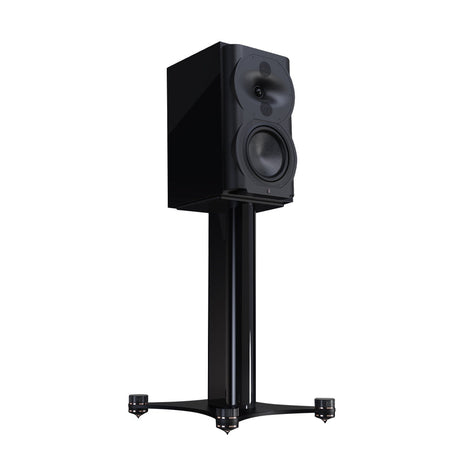
The Vienna Acoustics Liszt Reference takes the coincident driver technology of Vienna's Klimt Series and wraps it in a slim floorstanding cabinet with triple 7-inch Spidercone bass drivers that reach a genuine 28Hz. Designed by Vienna Acoustics founder Peter Gansterer and handmade in Vienna, the Liszt Reference puts its coincident driver's point source at the center of the midrange.
Key Features of the Liszt Reference
-
Coincident Flat Spider Cone Driver: 6-inch coaxial midrange with a proprietary Flat X4P Spidercone and integrated 3/4-inch ring dome tweeter featuring a neodymium magnet system and phase plug design
-
Triple 7" Spidercone Woofers: Three Flat X4P Spidercone bass drivers with recessed fabric center-cones, housed in a separate bass reflex enclosure reaching 28Hz
-
Mechanically Decoupled Music Center: The coincident driver module sits on one centered, high-grade aluminum turning mechanism, mechanically isolated from the bass cabinet and angled toward the listening position
-
Bessel Crossover Topology: Three-way crossover using 6dB and 12dB Bessel slopes with polypropylene capacitors (1% tolerance), air coils for midrange/tweeter, and special powder core inductors for the bass section
-
Separate Bass and Midrange Enclosures: Complete mechanical isolation between the woofer cabinet and the Music Center eliminates resonance transfer between the two sections
-
91dB Sensitivity / 4 Ohm Impedance: Compatible with quality amplifiers from 50 to 400 watts, equally at home with well-built tube amplifiers and solid-state designs
-
Four Premium Finishes: Piano Black, Piano White, Cherry, and Premium Rosewood (Rosewood at $22,995/pair, all others $19,995/pair)
-
7-Brace Internal Cabinet: Seven braces divide the bass cabinet into two chambers, one with a single woofer and one with two, each vented and uniquely tuned
The Coincident Driver: Point-Source Coherence
At the heart of the Liszt Reference is Vienna Acoustics' Flat Spider Cone coincident driver, the same fundamental technology found in The Music ($49,995) and The Kiss ($21,995). This 6-inch coaxial design places a ring dome tweeter with a phase plug and neodymium magnet system at the center of a flat, radially-vaned midrange cone. The result is a single coherent point source that covers the critical midrange and high frequencies without introducing crossover components through the vocal range.
The Liszt Reference uses the newer X4P cone material, upgraded from the original Liszt's earlier formulation. The flat cone surface eliminates the time and frequency-specific phase shifts that conventional curved cones produce. The ring dome tweeter extends response to 35kHz, well beyond the limits of human hearing, capturing the harmonic structure and air that gives acoustic instruments their natural character.

Bass Architecture: Triple Spidercone Array
The bass section uses three 7-inch Flat X4P Spidercone woofers with recessed fabric center-cones in a bass reflex configuration. These drivers are housed in their own independent enclosure, mechanically separated from the coincident driver module above. The triple-driver arrangement provides surface area equivalent to a much larger single driver while maintaining the speed and transient response that smaller cones handle naturally.
The bass reaches a genuine 28Hz, which means the Liszt Reference handles full orchestral bass, electric bass guitar, and organ pedal tones without the need for a subwoofer. The separate enclosure architecture means the woofers do their work without contaminating the purity of the coincident driver above, a design philosophy shared across the entire Klimt Series.
The Pivoting Music Center
The Liszt Reference's upper module (the "Music Center") connects to the bass cabinet through a precision aluminum pivoting mechanism. This lets you set the coincident driver at its optimal angle toward the listening position. The adjustment is precise, repeatable, and makes a real difference in image focus and soundstage width.
In practice, this creates a wider sweet zone rather than a narrow sweet spot. You dial in the toe-in with the pivot mechanism, reducing early side-wall reflections and broadening the area where the image locks into focus. It takes time to set up properly, but the result is a speaker that images with pinpoint precision across a generous listening area.

Crossover Design
Peter Gansterer's approach to crossover design prioritizes minimal signal degradation. The Liszt Reference uses a three-way crossover with 6dB and 12dB Bessel slopes, a topology chosen for its linear phase response and minimal ringing. The component quality reflects the price point: polypropylene capacitors held to 1% tolerance, air-core inductors for the midrange/tweeter section, and special powder core inductors for the bass section. Metal film resistors at 1% tolerance and inductance-free construction complete the signal path.
Cabinet Construction and Finishes
The Liszt Reference stands 47.6 inches tall on its base assembly (45.2 inches without), with a narrow 7.8-inch cabinet width that keeps the visual footprint minimal. Each speaker weighs 49 kg (108 lbs), which tells you about the internal bracing and driver mass involved. The bass cabinet uses seven internal braces that divide it into two chambers.
Four finishes are available: Piano Black, Piano White, Cherry and Premium Rosewood. The Rosewood finish carries a $3,000 premium ($22,995 versus $19,995 for all other finishes).
Explore Related Vienna Acoustics Models
The Liszt Reference shares its coincident driver technology with the Klimt Series, Vienna Acoustics' statement line named after the Austrian painter Gustav Klimt. Related models:
-
The Music is the Klimt Series flagship ($49,995), using three 9-inch woofers, a supertweeter, and the same coincident driver
-
The Kiss brings the coincident driver into a smaller design, sold with its stands ($21,995)
-
Poetry is the Klimt Series center channel, built on the same patented Flat-Spider-Cone coincident driver and designed to match The Music
-
Beethoven Concert Grand Reference brings Concert Grand series voicing to a floorstanding format
-
Maestro Grand Reference is the Concert Grand series center channel, which Vienna Acoustics designed as a no-compromise match for the Liszt Reference
The Listening Room Difference
We're a third-generation family business with a brick-and-mortar showroom in Chestertown, Maryland, and a reputation built on exceptional service and relentless passion for hifi. At this level, every detail matters, and we're here to make sure you get it right. Whether you need help with system matching, setup guidance, or just want to talk through your options before pulling the trigger, owner Mike Hoatson is a phone call away. We don't just ship boxes. We help build systems, and our support lasts well beyond the sale. Call or text 410-239-2020.
Vienna Acoustics Liszt Reference Specifications
| Specification |
Detail |
| System Type |
3-way bass reflex floorstanding speaker |
| Tweeter |
3/4" (19mm) ring dome diaphragm with phase plug and neodymium magnet system |
| Midrange |
6" (150mm) Flat X4P Spidercone (coincident with tweeter) |
| Woofers |
3 x 7" (180mm) Flat X4P Spidercone with recessed fabric center-cone |
| Crossover |
Three-way, 6dB and 12dB Bessel topology with polypropylene capacitors (1% tolerance), air coils for midrange/tweeter, special powder core for bass |
| Frequency Response |
28Hz - 35kHz |
| Sensitivity |
91 dB |
| Impedance |
4 ohms |
| Recommended Amplification |
50 - 400 watts |
| Dimensions Without Base (W x H x D) |
7.8 x 45.2 x 17.1 inches (198 x 1148 x 435 mm) |
| Dimensions With Base (W x H x D) |
11.6 x 47.6 x 17.1 inches (295 x 1210 x 435 mm) |
| Weight (per pair) |
98 kg / 216 lbs |
| Finishes |
Piano Black, Piano White, Cherry, Premium Rosewood |
| Country of Origin |
Austria (all cones manufactured by Vienna Acoustics in Austria) |