

Wilson Benesch: Technology & Design
A materials science company that makes loudspeakers
The Wilson Benesch Story
Wilson Benesch is a Sheffield-based engineering company that designs and manufactures loudspeakers, turntables, and cartridges from raw materials in-house. Family-owned since the late 1980s, they build everything from drive units to 3D-printed titanium components at aerospace-grade facilities.

Wilson Benesch is not a speaker company that dabbles in engineering. It is an engineering company that happens to make some of the world's finest loudspeakers, turntables, and phono cartridges. The distinction matters.
The company's origin predates its name. In the late 1980s, Craig Milnes wrote a government grant application proposing a turntable and tonearm built from carbon fiber composites, a materials technology that existed only in Formula 1 and aerospace at the time. The grant was approved, and with help from engineers who had worked on the Rolls-Royce RB-211 carbon fan blade program, Wilson Benesch launched its first products in 1990: the Wilson Benesch Turntable and the A.C.T. One Tonearm, the world's first carbon fiber tonearm. Both won awards globally, particularly in Japan and Germany, the most demanding high-end audio markets of the era.
In 1994, Wilson Benesch produced the A.C.T. One loudspeaker, the world's first loudspeaker with a curved carbon fiber composite enclosure. That same design introduced the 20-degree sloped top, a form that profoundly altered how a loudspeaker interacts with its environment by diffracting sound waves rather than reflecting them. Every sculpted top on today's Fibonacci speakers traces back to that 1994 decision.
The company remains entirely family-owned. Craig Milnes serves as Design Director, Christina Milnes as Managing Director, and Luke Sherwood as Sales and Marketing Director. They run the operation from Sheffield, answering to no investors or conglomerate owners. Every decision about research, manufacturing, and product development is funded purely from the profits of their own sales in the global marketplace.
What makes Wilson Benesch rare in the audio world is their vertical integration. They design and manufacture 95% of their components in-house from raw materials: all carbon fiber and biocomposite structures, all aluminium and steel components, and all drive unit technologies. Raw materials enter the 11,800-square-foot Falcon House facility in Sheffield. Finished products leave from the other end. Every component between those two points is bespoke.
They also work extensively with universities and research institutions. Their isotactic polypropylene driver cone was developed with Professor Ian Ward at the University of Leeds. Their 3D-printed titanium work connects them to the Advanced Manufacturing Research Centre (AMRC) in Sheffield, the same facility used by Boeing, Rolls-Royce, and McLaren. This is an audio company operating at the intersection of aerospace-grade materials science and music reproduction.
Almost 35 years in, the principles have not shifted.
The principles of innovation, collaboration and pure research within material science remain firmly at the heart of our ethos and approach to the development of the world's finest high-end audio products today.
- Craig Milnes, Design Director, Wilson Benesch
Why The Listening Room Carries Wilson Benesch
Every Wilson Benesch technology solves a specific acoustic problem, nothing is decorative. These speakers reward long listening sessions without fatigue, and the engineering is documented and transparent. White-glove delivery and setup included with every speaker and turntable purchase.
 Photo: Paul Elliott / PTA
The Listening Room carries brands that earn their place through engineering substance, not marketing volume. Wilson Benesch is the definition of that standard.
Every technology in a Wilson Benesch speaker exists to solve a specific acoustic problem. The carbon fiber monocoque eliminates cabinet resonance. The isobaric drive system delivers bass depth from a compact enclosure. The silk-carbon hybrid tweeter extends high-frequency response without the fatigue of metal domes. Nothing is decorative. Nothing is there for spec-sheet bragging rights. Every material choice traces back to a measurable acoustic improvement.
For customers who want to understand why their speakers sound the way they do, Wilson Benesch provides real answers grounded in physics and materials science, not marketing copy about "passion" and "heritage." The engineering is documented, the research is published, and the manufacturing is transparent. Luke Sherwood will walk you through every component and explain exactly why it's there. That level of intellectual honesty is something we value deeply at The Listening Room.
These speakers also reward long listening sessions in a way that few others do. The combination of isotactic polypropylene cones and silk-carbon tweeters produces a sound that is detailed without being analytical, fast without being bright, and musical without being colored. They do not fatigue. They do not shout. They simply get out of the way and let the recording speak.
We maintain Wilson Benesch as part of our permanent collection and feature them prominently at audio shows. White-glove delivery and setup by Mike Hoatson is included with every Wilson Benesch speaker and turntable purchase in the continental U.S.
The Technology Behind Wilson Benesch
Wilson Benesch is an R&D-first company. Every product begins with materials science research, not with a target price or a marketing brief. The technologies below are the result of decades of collaboration with universities, aerospace research centers, and polymer scientists.
Most audio manufacturers design a product, then source components to build it. Wilson Benesch works the other way around. They start with the materials: carbon fiber composites, isotactic polypropylene, titanium, biocomposites. They study how these materials behave acoustically, what properties they offer, what problems they solve. Only then do they design products around what the science makes possible.
This section walks through the core technologies that define every Wilson Benesch loudspeaker, turntable, and cartridge. Each one exists to solve a specific acoustic or mechanical problem, and each one is manufactured in-house at the company's Sheffield facility. Nothing is outsourced. Nothing is off-the-shelf.
We literally take a design, we get raw materials that then go into our machine shop. We create components that are completely bespoke for our purposes and our purposes only. And that then populates and is built by hand by our technicians into a completely bespoke product.
- Luke Sherwood, Sales & Marketing Director, Wilson Benesch
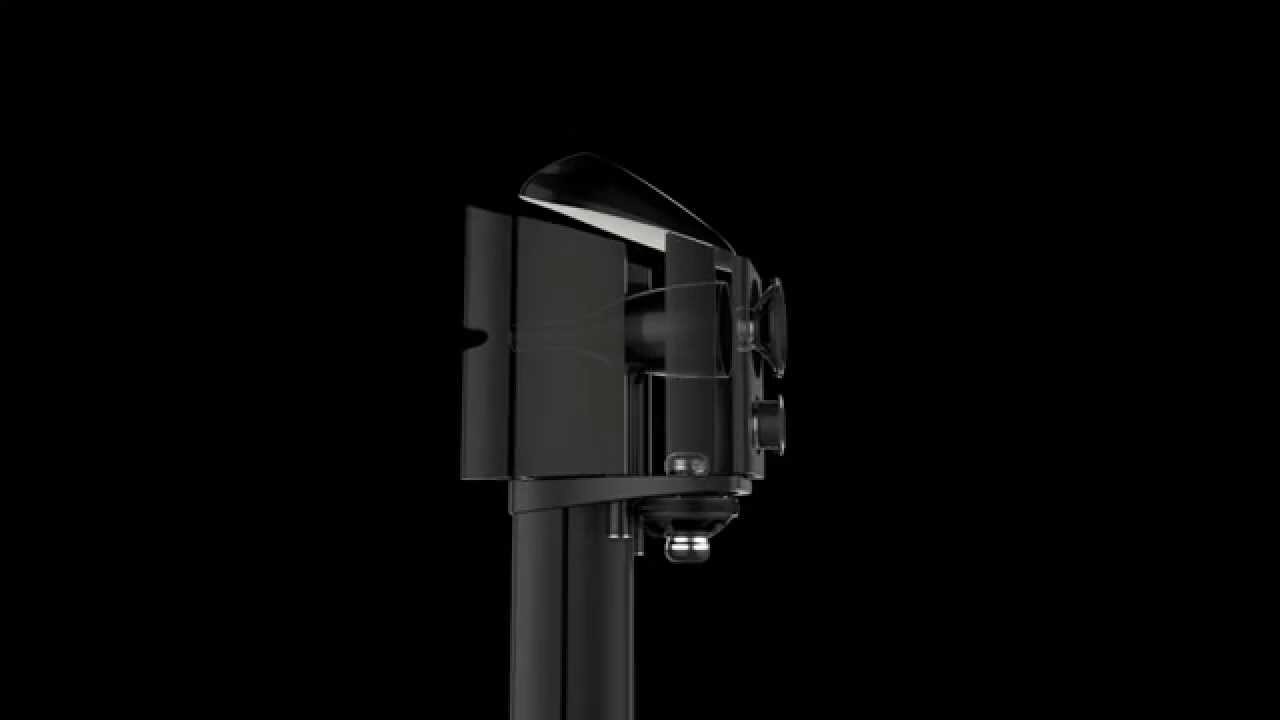
Timing and Transient Speed
Wilson Benesch designs around a single conviction: the human ear is more sensitive to timing than to pitch or loudness. Every technology in the Fibonacci series, from isobaric bass to reductive crossovers, exists to preserve the microsecond accuracy of natural sound.

Timing and Transient Speed
Most loudspeaker manufacturers optimize for frequency response, sensitivity, or maximum output. Wilson Benesch starts from a different premise entirely: fidelity is timing. If the transient behavior of a loudspeaker does not match the speed of the original event, the signal has already been corrupted before any frequency measurement matters.
The reasoning is grounded in psychoacoustics. Humans can detect timing differences of just a few microseconds, a sensitivity far more acute than our ability to perceive changes in pitch or loudness. Timing governs rhythm, the spatial placement of instruments, and the sense of a live performance unfolding in real time. Any mechanical, electrical, or acoustic delay introduced by the loudspeaker is a direct loss of fidelity from the original recording.
Wilson Benesch frames this with a design mantra borrowed from physics: "There are no transient delays in nature." A plucked guitar string, a struck snare drum, a singer's breath, each event begins and ends instantly. A loudspeaker should do the same. When it cannot, the result is smeared transients, blurred imaging, and the subtle loss of musical flow that listeners experience as fatigue without being able to name it.
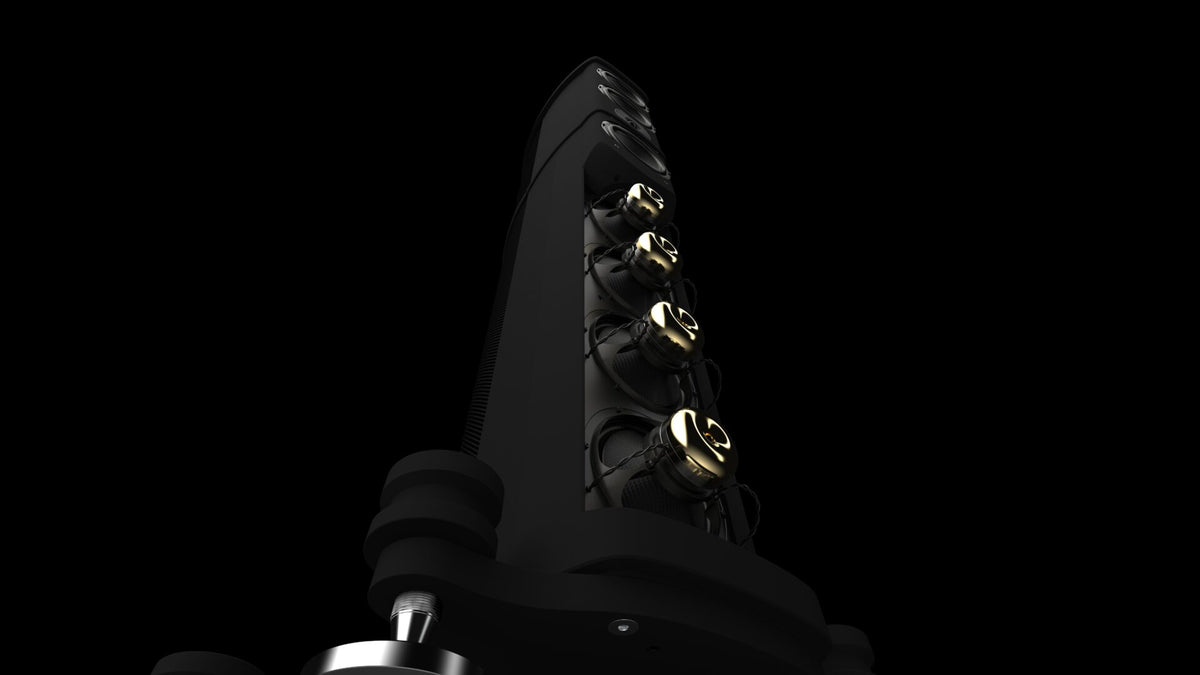
Colin Chapman of Lotus famously said that adding power makes you faster on the straights, but subtracting weight makes you faster everywhere. Wilson Benesch applies the same logic to driver design. Rather than using large, heavy woofers that move slowly and overshoot their intended position, they pair lightweight isotactic polypropylene cones with high-power rare-earth motors in an isobaric configuration. The dual-motor system adds power. The ultra-light cones subtract weight. The result is bass that starts and stops with the speed and precision of a midrange driver.
This philosophy extends through every engineering decision: reductive crossover design that minimizes phase shift, first-order filters that preserve time coherence, directly amplifier-coupled midrange drivers that bypass the crossover entirely, and the A.C.T. 3Zero biocomposite monocoque that eliminates cabinet-borne delays. The step response of a Wilson Benesch isobaric bass system is often comparable to, and sometimes faster than, the midrange. That alignment is the whole point. Rather than the bass lagging behind the rest of the spectrum, the entire speaker speaks with a single voice.
Carbon Fiber Composite Monocoque Enclosures
Wilson Benesch uses F1-grade carbon fiber composites to build monocoque chassis that are simultaneously rigid and damped. Their latest A.C.T. 3Zero biocomposite monocoque advances both acoustic performance and sustainability. Thinner walls mean more internal volume, and every curve serves an acoustic purpose.

Carbon Fiber Composite Monocoque Enclosures
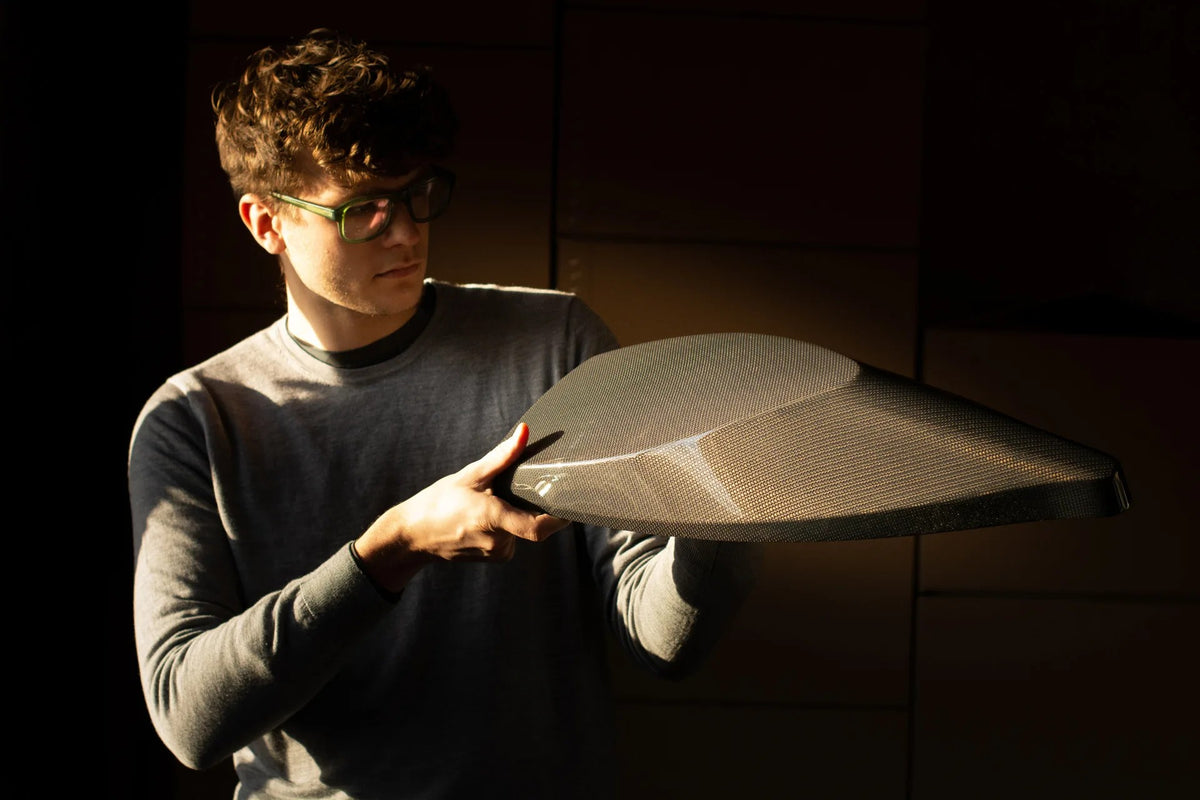
Most loudspeaker cabinets are built from MDF or HDF with internal bracing to control resonance. Wilson Benesch takes a fundamentally different approach. Their enclosures use a monocoque chassis construction, the same structural principle used in Formula 1 cars and aircraft fuselages, where the outer skin itself is the structure. No internal bracing required.
The key distinction is that Wilson Benesch uses carbon fiber composites, not carbon fiber alone. Many companies in the audio industry use carbon fiber as a visual element, essentially a veneer. Wilson Benesch uses it as an engineering solution.
The composite structure brings together two properties that are normally at odds: stiffness and damping. Carbon fiber provides extreme rigidity, resisting resonance and vibration. The composite layer adds damping, absorbing and dissipating energy rather than allowing it to ring. The curved surfaces of the enclosure further increase structural rigidity while reducing internal standing waves.
Thinner walls are a practical benefit of this approach. Even a quarter-inch reduction in wall thickness on all dimensions creates significantly more internal volume. More volume gives the speaker designer greater flexibility in tuning low-frequency response. The result is speakers that combine the bass capability of a much larger cabinet with the imaging precision of a smaller one.
The Fibonacci Series introduced Wilson Benesch's A.C.T. 3Zero biocomposite monocoque, a significant advance in both acoustic performance and environmental responsibility. The 3Zero monocoque incorporates natural, renewable, and sustainable materials alongside carbon fiber, representing a deliberate move toward greener manufacturing without compromising structural integrity. The biocomposite achieves the same extraordinary stiffness-to-damping ratio while reducing the environmental footprint of production.
The sculpted top piece on each speaker is not aesthetic flourish. It is engineered to diffract and disperse acoustic waves, helping the speaker disappear in the listening room. Every curve serves a purpose.
The objective was to create something that was very, very stiff, so that it was rigid and inert and resisted resonating. But also something that could be used in a composite structure. The advantage of using carbon fiber composites, not carbon fiber, is that you're bringing together stiffness, but also then by adding another material, you get the properties of damping.
- Luke Sherwood, Sales & Marketing Director
Steel Tie Rod Compression System
Instead of conventional internal bracing, Wilson Benesch locks the monocoque under tons of compressive force using 13mm threaded steel bars. This pre-loads the cabinet against vibration before a single note plays.

Steel Tie Rod Compression System
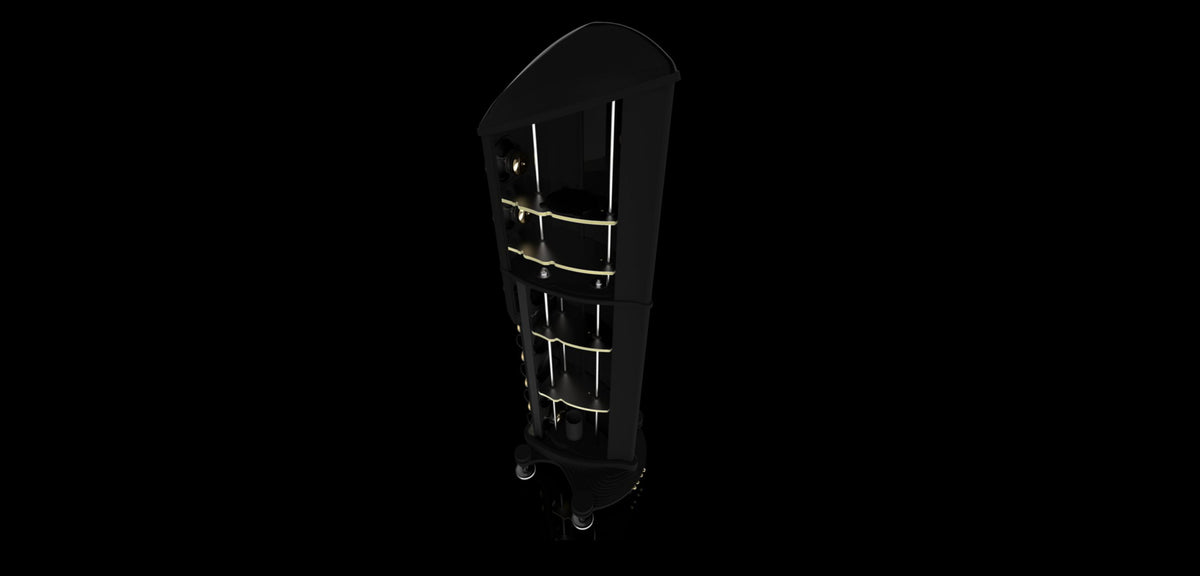
Where most manufacturers fight cabinet resonance by adding internal bracing and damping material after the fact, Wilson Benesch takes the opposite approach. They engineer resonance out structurally, locking the entire monocoque under tons of compressive force.
Threaded 13mm steel bars run vertically through the enclosure, tying from the aluminium mid-plate into the foot and up into the top-plate. These steel ties exert compressive force along the vertical axis, precisely where the first resonant modes would emerge. The result is a cabinet that is pre-loaded against vibration before a single note plays.
This compression architecture does more than suppress vibration. It fundamentally changes the resonant profile of the enclosure, pushing unwanted energy out of the audible band. The cabinet becomes acoustically invisible, contributing nothing of its own character to the sound. Where other manufacturers stuff their boxes with braces and damping material, Wilson Benesch eliminates the problem at the structural level.
The approach extends from the smallest speaker in the range to the flagship Eminence, where the foot structure is machined from a 120kg aluminium billet. At every price point, the principle is the same: lock the structure under compression so the enclosure works with the drivers rather than against them.
Isotactic Polypropylene Drive Units
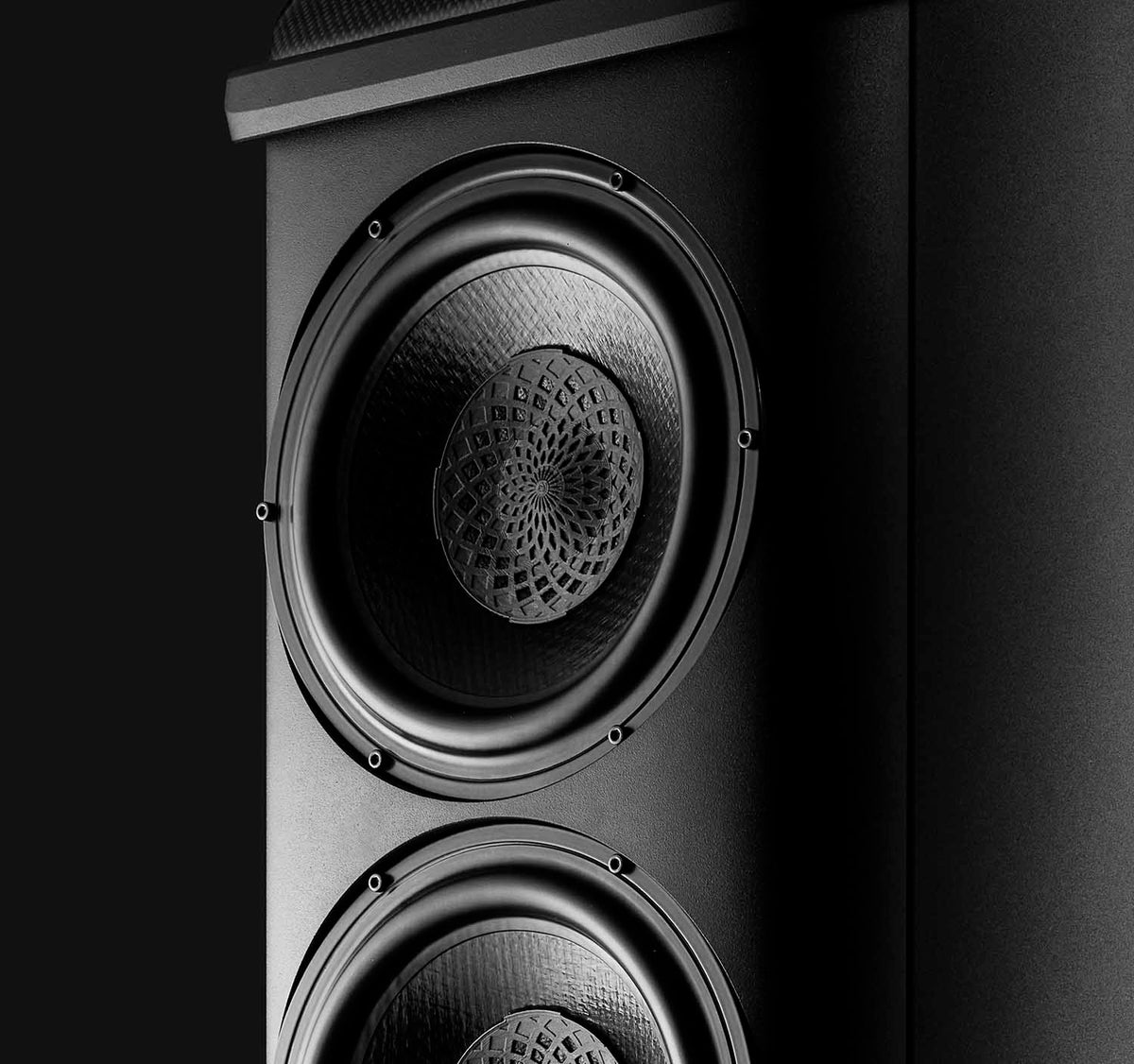
Co-developed with the University of Leeds, the Tactic driver's isotactic polypropylene cone hits the sweet spot between stiffness and damping. Stiffer than standard polypropylene, more damped than metal or carbon, and light enough for excellent transient response.

Isotactic Polypropylene Drive Units
The Tactic drive unit is Wilson Benesch's proprietary mid-bass and midrange driver, and its cone material is one of the company's most significant innovations. Developed in partnership with Professor Ian Ward, a polymer physicist at the University of Leeds, the isotactic polypropylene cone represents years of materials research into finding the ideal driver diaphragm.
At the chemical level, isotactic polypropylene forms a helix structure within its molecular bond. This gives it significantly more stiffness than standard polypropylene, enough to maintain its form under the pistonic movements required of a loudspeaker driver at audio frequencies. But because it is a woven material, it also has excellent damping properties.
Wilson Benesch deliberately chose this material over alternatives. They tested metal domes and carbon fiber composite diaphragms, both of which offer high stiffness. But those materials created complex breakup modes within the diaphragm, producing a sibilant, fatiguing quality. To control that breakup, you would need more crossover components, which introduce their own penalties: reduced efficiency, spring effects, and phase discontinuities.
The isotactic polypropylene cone avoids these tradeoffs entirely. It is stiff enough for accurate reproduction, damped enough to avoid breakup-mode distortion, and light enough for excellent transient response. Different weave patterns, thicknesses, and configurations allow Wilson Benesch to tune the cone for specific driver applications across their range.
The company does use carbon fiber diaphragms in one application: the IGX infrasonic generator subwoofer, where extreme pistonic air movement from a very stiff diaphragm is the primary requirement, and the crossover point is well below the frequency range where breakup-mode distortion would be audible.
We looked at the idea of using metal domes, and we looked at the idea of using carbon fiber composite diaphragms as well. But what we found was that that created quite a lot of complex breakup modes within the diaphragm, and we didn't like that sound, that sibilant kind of quality to those drive units.
- Luke Sherwood, Sales & Marketing Director
Tactic 3.0 and the Fibonacci Element
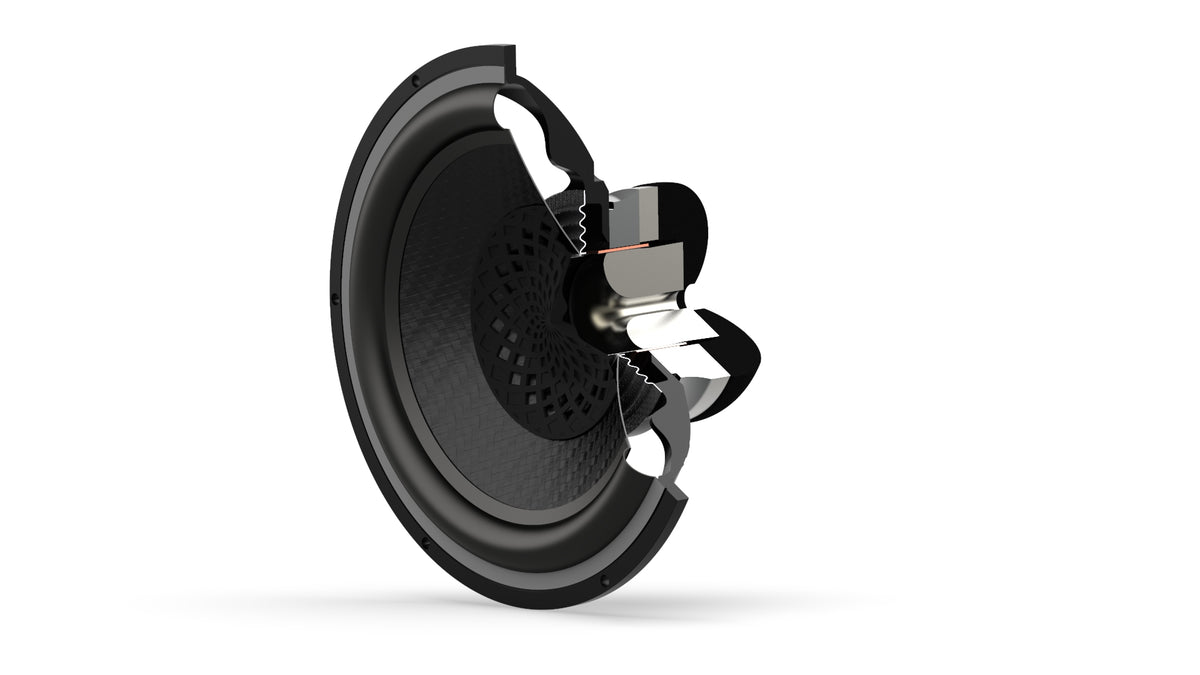
The third generation of Wilson Benesch's proprietary drive unit adds a 3D-printed dust cap called the Fibonacci Element, using five materials to fine-tune crossover integration. Additive manufacturing allows control over stiffness and weight that injection molding could never achieve.

Tactic 3.0 and the Fibonacci Element
The Tactic 3.0 is the current generation of Wilson Benesch's proprietary drive unit, and its most significant advance sits at the center of the diaphragm. The structure commonly called a "dust cap" is, in this context, anything but a dust cover. Wilson Benesch calls it the Fibonacci Element, and it plays a critical role in the driver's behavior across its operating bandwidth.
Produced in-house using additive manufacturing technology, the Fibonacci Element is built from a carbon fiber and nylon matrix, printed layer by layer according to precisely defined parameters. The additive process gives Wilson Benesch control that injection molding cannot approach: they can see each layer in cross-section during design, adjusting the density, stiffness, and geometry of the structure in three dimensions before committing to manufacture.
The resulting form features a double curvature with both open and closed aspects arranged in a lattice structure drawn from natural geometry. Five different materials and adhesives work together to manage the relationship between the cone's mechanical behavior and its acoustic output. This is a critical detail. The dust cap is the bridge between the main cone area and the crossover integration point where the driver hands off to the tweeter above and the bass section below. In previous generations, multiple discrete materials were used to fine-tune this marriage. Additive manufacturing opened a new chapter, allowing the principal aspects of the structure, its stiffness, damping, and mass distribution, to be adjusted simultaneously in ways that were previously impossible.
The practical result is a drive unit with improved accuracy in its frequency response and measurably lower distortion across its passband. For the listener, this translates to a midrange that is more transparent, more resolving of low-level detail, and more seamlessly integrated with the Fibonacci tweeter above it.
Direct Amplifier Coupling and Reductive Crossover Design
In most Fibonacci Series models, the midrange driver runs with zero crossover components, directly coupled to the amplifier output. First-order filters throughout the rest of the system minimize phase shift and preserve timing coherence.


Direct Amplifier Coupling and Reductive Crossover Design
Every component in a crossover network, every inductor, capacitor, and resistor, introduces phase shift, signal loss, and a spring-like energy storage effect that smears transient response. Wilson Benesch's position on crossovers is straightforward: use as few components as possible, and where you can eliminate them entirely, do so.
In most Fibonacci Series loudspeakers, the midrange Tactic 3.0 drive unit runs directly amplifier coupled. No high-pass filter. No low-pass filter. No crossover components at all between the amplifier output and the driver terminals. The midrange sees the full, unfiltered signal from the power amplifier, reproducing everything within its natural operating bandwidth without electrical interference.
This is only possible because Wilson Benesch designs and manufactures their own drive units. The isotactic polypropylene cone material, developed with the University of Leeds, absorbs energy and avoids the complex breakup modes that plague harder diaphragm materials. Those breakup modes are precisely the problem that crossover components exist to solve in conventional speakers. Because the Tactic cone does not break up within its operating range, the crossover components become unnecessary. Removing them preserves phase linearity, maintains the full dynamic range of the amplifier-driver connection, and eliminates a significant source of timing errors.
The remaining drivers in the system use first-order filters wherever possible. First-order crossovers have the gentlest slope (6 dB per octave) and the least phase shift of any filter topology. The isobaric bass sections typically use a first-order low-pass filter, and the Fibonacci tweeter uses a second-order high-pass filter at 5 kHz. Even the Eminence, with its ten drive units, uses this reductive approach throughout.
The philosophy mirrors the timing obsession that runs through every Wilson Benesch design. Fewer components means less stored energy, less phase rotation, and faster transient response. The signal path from amplifier to air remains as short and clean as the engineering allows.
Isobaric Drive Technology
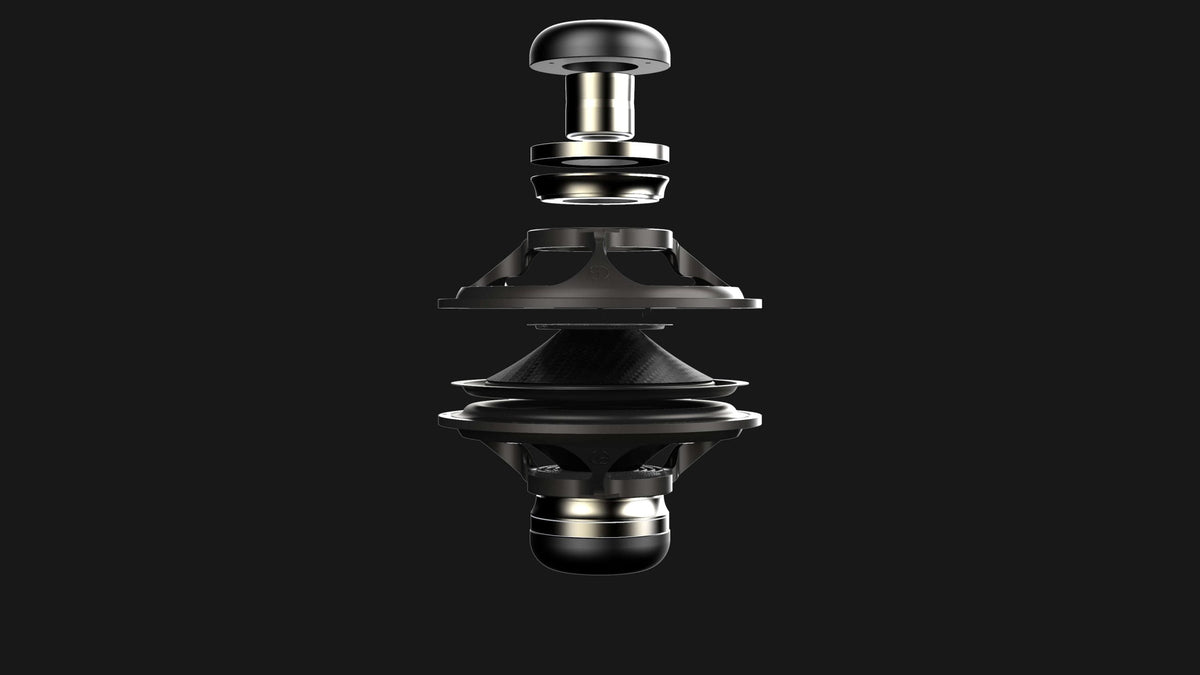
Two matched drivers coupled as one, delivering the bass of a speaker twice its size from a compact enclosure. Fast start-stop response means tight, articulate bass. Every Fibonacci series speaker uses this configuration.

Isobaric Drive Technology
Wilson Benesch is one of the few speaker manufacturers that consistently uses isobaric drive systems across its product range. The principle is straightforward: two matched drive units coupled together, acting as a single driver with two motors. The execution, however, is anything but simple.
Wilson Benesch is one of the few speaker manufacturers that consistently uses isobaric drive systems across its product range. The principle couples two matched drive units together, acting as a single driver with two motors. The execution is demanding, which is why almost nobody else does it.
The primary advantage is often described in terms of size: you get the bass output of a driver twice its physical size from half the cabinet volume. But Wilson Benesch frames the value differently. For them, the isobaric configuration matters because of timing. Two ultra-light diaphragms, tightly coupled and powered by high-strength rare-earth motors, start and stop faster than any single large woofer can. The step response of the Wilson Benesch isobaric bass system is often comparable to, and in many cases faster than, the midrange driver. That alignment is the design goal: the entire loudspeaker speaks with a single voice, with bass that arrives at the same instant as the rest of the spectrum.
Wilson Benesch first implemented isobaric loading with the Tactic 1.0 drive unit in the Bishop loudspeaker of 1999. The Tactic 1.0 was developed through a £250,000 R&D programme part-funded by the UK Department of Trade and Industry. That landmark project established Wilson Benesch's in-house drive unit capability and laid the groundwork for decades of continuous development in isobaric bass systems.
Despite its advantages, isobaric loading remains rare. Pairing two drivers halves the system sensitivity (a 3 dB loss), requiring more amplifier power. The engineering is more demanding: two perfectly matched drive units, dual motor assemblies, and a precision coupling structure add significant cost and complexity. Most manufacturers avoid it entirely. Wilson Benesch overcomes these challenges because they build their own drivers to exact tolerances, and modern amplifier technology has made the modest sensitivity loss a non-issue.
Wilson Benesch speakers are not difficult loads despite using isobaric systems throughout. Sensitivities typically measure 89-90 dB with nominal impedance of 6 ohms, dipping toward 4 ohms at worst. Wilson Benesch does not voice their speakers around any single amplifier type. The company's founders use both valve and solid-state amplifiers at home and in the development facility, ensuring that the speakers partner successfully with the widest possible range of electronics.
With the sole exception of the Horizon (the entry-level floorstander), every loudspeaker in the Fibonacci Series uses an isobaric drive system for bass reproduction. From the compact Discovery 3Zero to the flagship Eminence, the isobaric principle is the defining technology of the range.
You can get the same or near enough the same bass output from effectively half the size. And that's very important where control of energy within the enclosure is concerned. Integration across the midrange and the bass is very important, which is another really key point to our philosophy.
- Luke Sherwood, Sales & Marketing Director
Silk-Carbon Hybrid Tweeter
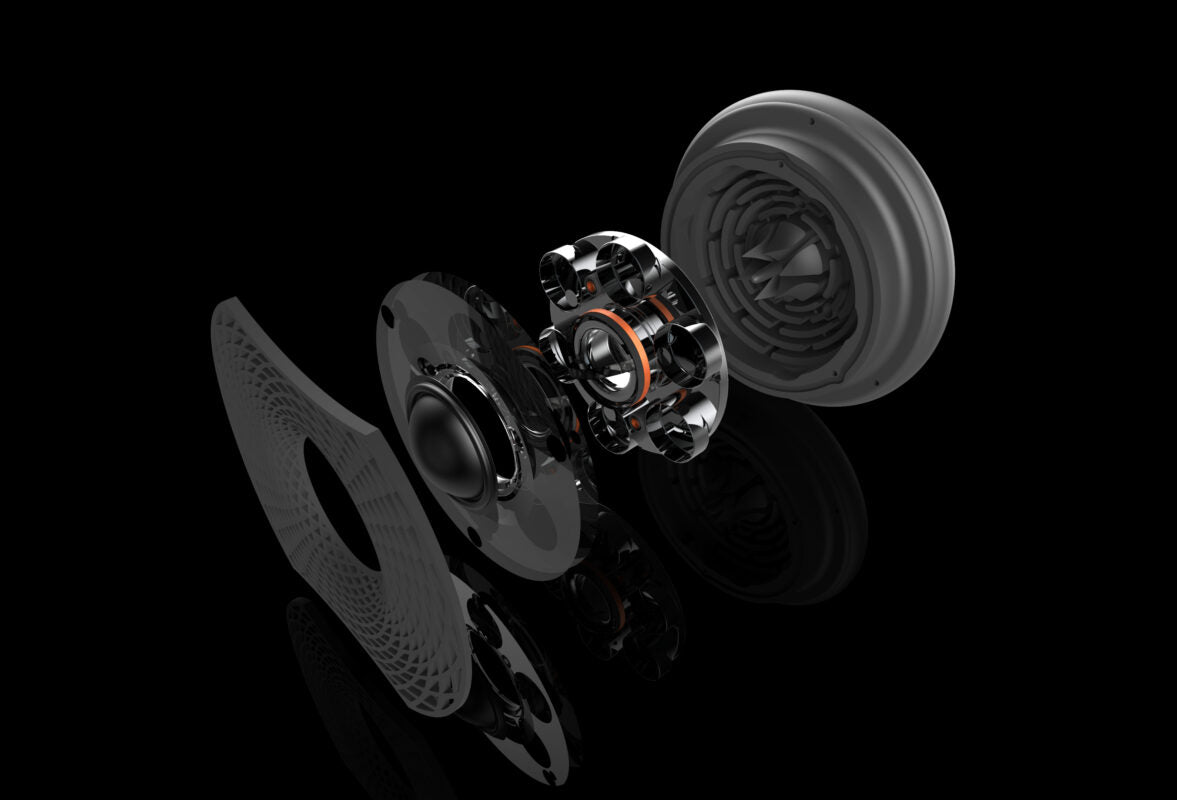
A silk dome reinforced with a carbon fiber halo that pushes breakup frequency from 18kHz to beyond 30kHz. Weight penalty: 0.01 grams. Silk smoothness with metal-dome bandwidth, minus the fatigue.

Silk-Carbon Hybrid Tweeter
The Wilson Benesch tweeter solves one of the oldest problems in speaker design: how to get the smooth, non-fatiguing character of a silk dome with the extended bandwidth and precision of a metal or diamond dome.
Standard silk dome tweeters produce a beautifully smooth, natural sound. The problem is that they begin to deform and break up above approximately 18-20 kHz, introducing distortion at the edge of audibility. Metal and beryllium domes extend much higher, but they bring their own problems: ringing, sibilance, and listener fatigue.
Wilson Benesch's solution is characteristically elegant. They hand-apply ultra-fine tows of carbon fiber (3,000 individual filaments per strand) under magnification, forming an arched halo across the dome's crown and a reinforcing ring around its base. This carbon fiber structure reinforces the weakest point of the silk dome, the middle section that collapses first during high-frequency excursion, pushing the breakup frequency from 18 kHz to beyond 30 kHz.
The weight penalty is functionally zero: 0.01 grams. The sonic benefit is immense. You get the sweet, non-sibilant character of silk through the entire audible range, with the extended bandwidth to reproduce high-resolution audio formats faithfully. No crossover components are needed to tame ringing because the silk provides inherent damping. The result, as The Absolute Sound's Robert Harley wrote, is a tweeter that is "richly detailed and alive, yet not etched or overbearing."
Behind the dome sits the Labyrinth Enclosure, the first additively manufactured rear chamber for a high-frequency driver in high-end audio. Manufactured using 3D printing from a carbon fiber-doped nylon composite, this structure features a maze-like periphery interwoven with finger-like protrusions that trap and dissipate the tweeter's back wave before it can reflect and interfere with the forward output. The complex internal geometry was literally impossible to manufacture before modern additive technology. It eliminates comb filtering (the interference between delayed back-wave energy and the direct output) that compromises lesser tweeters.
The Fibonacci Element faceplate, the Labyrinth Enclosure, and a rare earth magnet motor system complete the tweeter architecture. All are designed, manufactured, and hand-built under one roof in Sheffield.
We added a structure into that dome that would allow us to push the resonant frequency higher and allow us to maintain that pistonic response, such that we can get to around about 30 kilohertz with the silk dome. And there's no weight penalty because it is 0.01 grams, which is like a skirt of a coffee bean.
- Luke Sherwood, Sales & Marketing Director
Fibonacci Waveguide
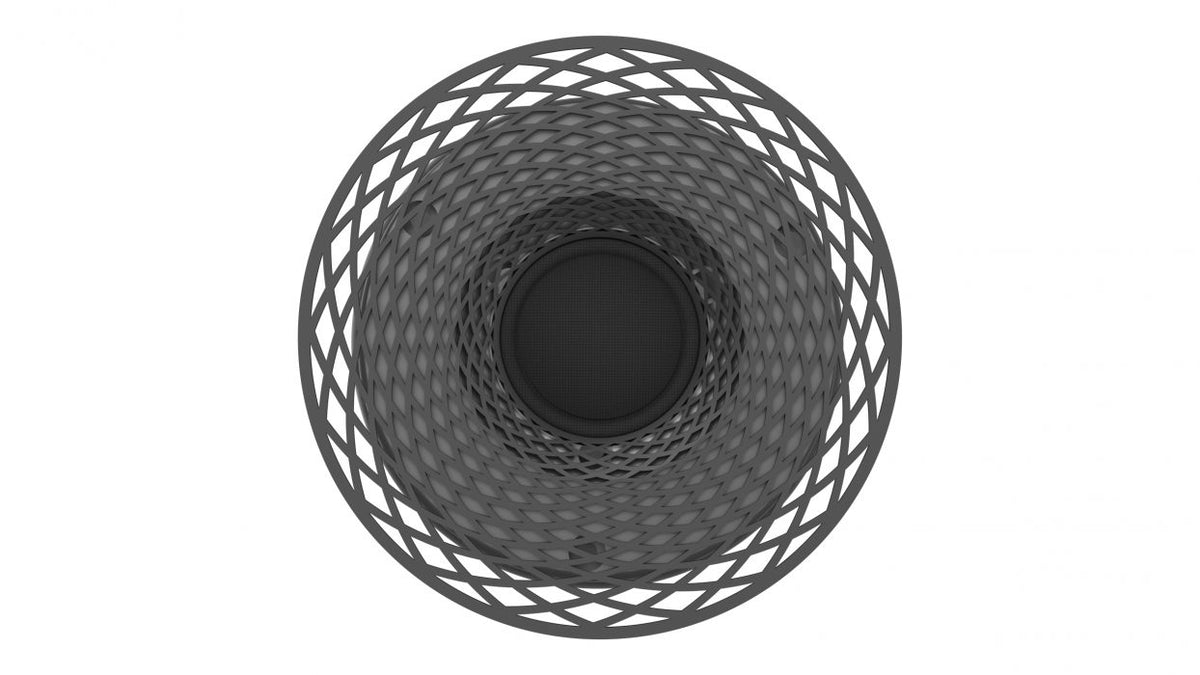
The distinctive patterned ring around the tweeter spreads high-frequency energy more evenly through the room, widening the sweet spot. Named for the golden ratio and manufactured via 3D printing.

Fibonacci Waveguide
The Fibonacci waveguide is the distinctive patterned ring surrounding the tweeter on Wilson Benesch's current loudspeaker range, and it gives the Fibonacci series its name. Named after the Italian mathematician who identified the golden ratio and its presence in natural structures, from flower petals to the human liver, the waveguide serves a very specific acoustic function.
Tweeters are inherently directional. Higher frequencies have shorter wavelengths that beam straight forward rather than dispersing into the room. The Fibonacci waveguide acts as a horn-like structure that spreads high-frequency energy more evenly throughout the listening space. The result is a wider sweet spot and more consistent tonal balance across different seating positions.
Critically, the waveguide is bonded to the baffle, not to the tweeter structure itself. This means energy created by the tweeter's rapid movement does not transfer into the waveguide, preventing it from developing its own resonant signature. The decoupling is deliberate and matters acoustically.
The organic, nature-inspired pattern is partly functional (the curves follow principles similar to Wilson Benesch's earlier machined aluminum waveguides) and partly a statement of manufacturing capability. As Luke Sherwood notes with characteristic directness: "We thought it'd be really clever to put it on the front of our tweeter, because we can." The pattern follows the golden ratio structure that Fibonacci described, a fitting emblem for a company that finds engineering inspiration in the mathematical patterns underlying nature.
The waveguide is manufactured using the same additive 3D printing technology as the tweeter's labyrinth enclosure, allowing geometric complexity that would be impossible with traditional machining.
Additive Manufacturing and 3D-Printed Titanium
3D-printed components in carbon fiber-nylon and aerospace-grade titanium. Enables geometric complexity impossible with traditional machining. Developed with Boeing's AMRC research center in Sheffield.


Additive Manufacturing and 3D-Printed Titanium
Wilson Benesch was an early adopter of additive manufacturing (3D printing) in the audio industry, and they remain one of the most sophisticated users of the technology. Multiple components across their loudspeaker, turntable, and tonearm ranges are produced using additive processes, each chosen for the geometric complexity it enables.
The Fibonacci Element (the dust cap on Tactic drive units) is 3D printed from a carbon fiber and nylon matrix. Manufactured layer by layer, it allows Wilson Benesch to optimize density, stiffness, and geometry in ways impossible with traditional injection molding. This component works in conjunction with the isotactic polypropylene cone to further damp the driver, controlling breakup modes and improving clarity.
The tweeter's labyrinth rear enclosure is another example: a complex internal structure with tulip-like projections designed to scatter the tweeter's back wave. You could not manufacture this kind of geometry by removing material from a solid block. You can only create it by building it up, layer by layer.
Perhaps most impressive is Wilson Benesch's work with 3D-printed titanium, developed in collaboration with the Advanced Manufacturing Research Centre (AMRC) in Sheffield. Titanium melts at approximately 3,000 degrees Fahrenheit, making it extraordinarily challenging to work with in additive processes. Wilson Benesch uses 3D-printed titanium for tonearm components in their turntable range, achieving structural geometries that would be impossible with conventional machining.
Wilson Benesch was also an early adopter of generative AI in component design, using AI-driven software as early as 2019 to inform the complex three-dimensional structures of components like the labyrinth enclosure. The computer generates optimized geometries that would be impractical for a human to design manually in a CAD package.
It's by collaborating with people who are experts in a given field that you are able to really push the envelope in materials and engineering. It wouldn't have been possible to develop the technologies that we have, had we not worked in that kind of collaborative spirit.
- Luke Sherwood, Sales & Marketing Director

Precision CNC Manufacturing
Wilson Benesch machines over 150 individual components from raw aluminium and steel billets at their 11,800 sq ft Sheffield facility. The Eminence foot alone requires six hours of continuous CNC machining from a 120kg aluminium slab. Every product is built to order.


Precision CNC Manufacturing
Wilson Benesch did not start as a manufacturing company. When Craig Milnes founded the business in 1989, every component was outsourced to OEM suppliers. That changed in 1995, when profits from the A.C.T. One's commercial success funded a major investment in CNC machining equipment and a trained engineer to operate it. That decision established the reciprocal relationship between design and manufacturing that defines the company today.
The Sheffield facility has grown from a 700-square-foot corner of Falcon House (a former food company headquarters) to an 11,800-square-foot integrated design and manufacturing plant. Wilson Benesch owns the entire building and added 4,800 square feet in 2020 to meet growing demand. Under this one roof sits the capacity to design and manufacture to aerospace-grade tolerances in a broad range of metals and advanced composite materials.
The numbers tell the story. Wilson Benesch's machine fleet produces over 150 individual components across the product range. An A.C.T. 3Zero alone contains 12 unique machined components, excluding those in the drive units and tweeters. Each must be cut to exact tolerances by trained engineers running multi-axis CNC mills and lathes. The smallest components are the termination plugs on the Tactic 3.0 drive unit. The largest is the Eminence foot, machined from a 120 kg slab of high-grade aluminium alloy over almost six hours of continuous operation. Hundreds of thousands of lines of G-Code subtractively reduce that raw billet to the complex terraced geometry of a 30 kg loudspeaker foot.
Every Wilson Benesch product is built to order in a just-in-time manufacturing system. There is no warehouse of pre-built inventory. When a customer orders an Eminence or a Discovery 3Zero, that specific pair enters production at Falcon House. Raw materials, aluminium billets, steel bars, carbon fiber fabric, resin, enter from one end. A finished, bespoke loudspeaker leaves from the other. The scale is deliberately small, the tolerances are deliberately tight, and the result is a product built with a precision that volume manufacturing cannot replicate.
IGX Infrasonic Generator
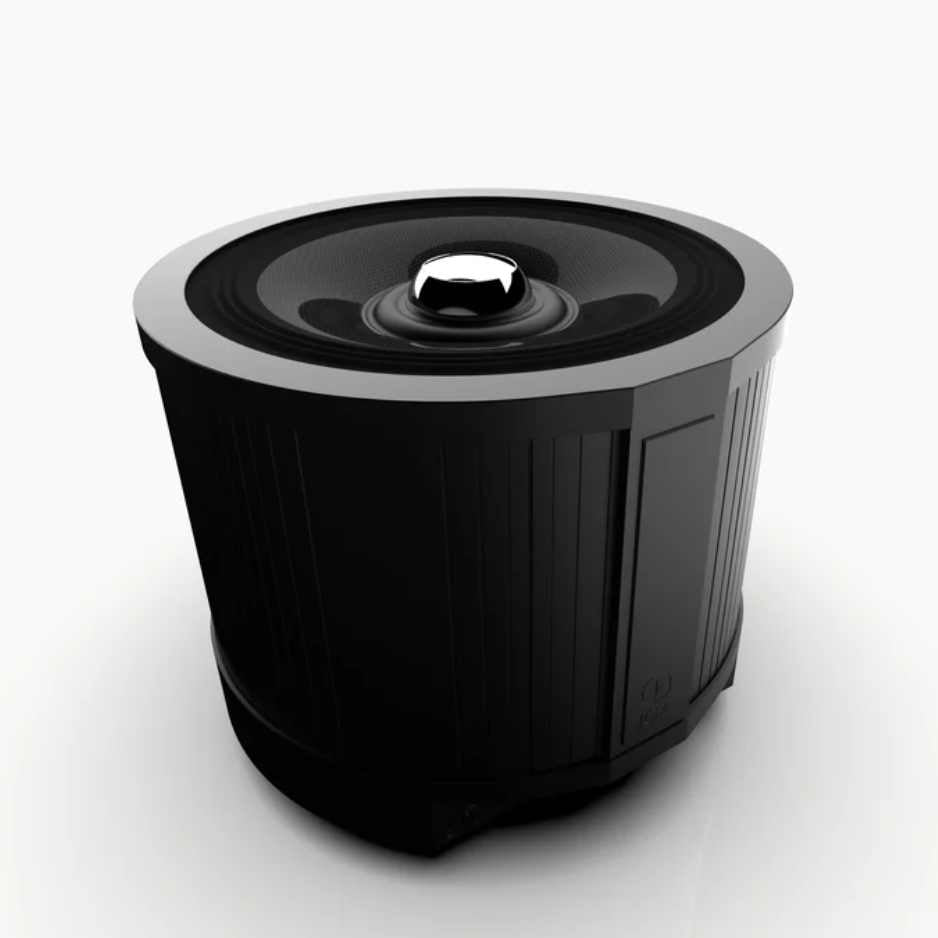
An 18-inch carbon fiber driver in a drum-shaped enclosure with dual push-pull magnets. Not built like a conventional subwoofer: no basket, vertical orientation, and designed for speed above all else.

IGX Infrasonic Generator
The IGX is not called a subwoofer because it is not built like one. Wilson Benesch designed the Infrasonic Generator from scratch to solve a specific problem: extending bass response below the range of their Fibonacci speakers without sacrificing the speed and articulation that defines the WB sound.
The 18-inch driver uses a carbon fiber diaphragm, not the isotactic polypropylene found in the Fibonacci range. At these frequencies and excursions, the priority shifts to extreme pistonic stiffness. The carbon fiber cone maintains its shape under the massive air displacement required for infrasonic reproduction.
The dual magnet structure operates in a push-pull configuration. Luke Sherwood describes it as "four-wheel drive on one diaphragm." One magnet pushes while the other pulls, providing far greater control over the driver's movement than a single motor. This reduces distortion and increases the driver's ability to start and stop precisely.
The enclosure is oriented vertically in a drum shape. Drums are inherently stiff structures because they have no flat panels. Flat panels flex and resonate. By eliminating them entirely, Wilson Benesch created an enclosure that contributes virtually nothing of its own character to the sound.
Inside, there is no conventional basket holding the driver. The motor assembly connects directly to the enclosure structure via a pole and suspension. This minimalist approach reduces mass and eliminates potential resonance paths between the driver and the cabinet.
Speed is the design philosophy throughout. The IGX is meant to integrate seamlessly with the fast bass response of the Fibonacci speakers, filling in the bottom octaves without introducing the timing lag and bloom that plague most subwoofers. The result is a system where the bass and midrange share the same sense of pace and rhythm.
The Analog Collection
Wilson Benesch has been engineering analog playback systems since 1990, when they launched the world's first carbon fiber tonearm. The GMT platform now spans three turntables, from the Greenwich entry point to the flagship GMT One, all sharing the same ALPHA-OMEGA direct drive architecture.
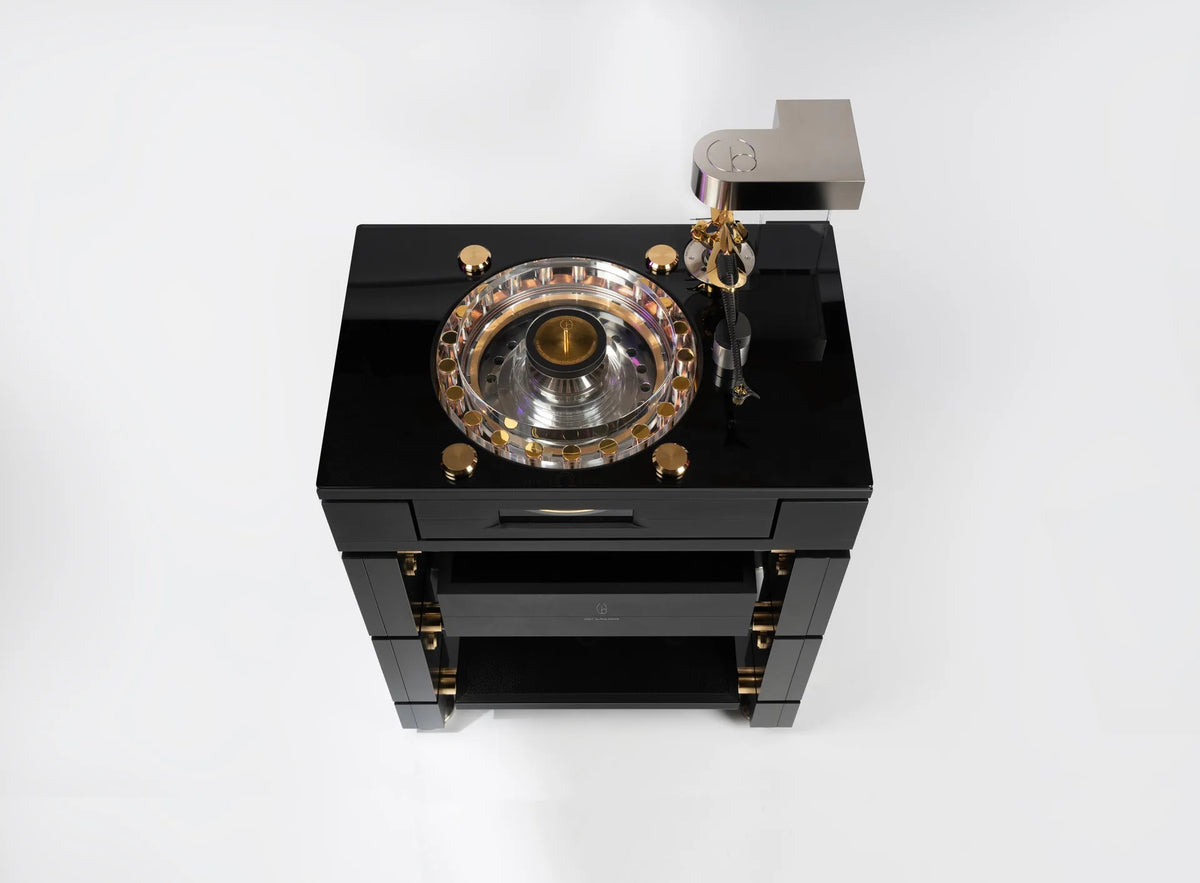
Wilson Benesch's history in analog predates their loudspeaker work. The company's founding grant application, written before the Wilson Benesch name even existed, proposed developing a turntable and tonearm using carbon fiber composite technology borrowed from the aerospace industry. The A.C.T. One Tonearm launched in 1990 as the world's first carbon fiber tonearm, built with the help of engineers who had worked on the Rolls-Royce RB-211 carbon fan blade program. It won awards in Japan and Germany at a time when those were the most demanding high-end audio markets in the world.
That was the beginning. In the decades since, Wilson Benesch has applied every advance in materials science and manufacturing, carbon composites, additive manufacturing in titanium, precision CNC machining, piezo actuation, to the problem of extracting musical information from a vinyl groove. The result is the GMT Collection: a turntable, tonearm, and cartridge system designed as an integrated whole, with over thirty patented innovations developed by the GMT Consortium and manufactured entirely at Falcon House in Sheffield. The platform now spans two turntables, from the Greenwich to the flagship GMT One, sharing the same ALPHA-OMEGA direct drive architecture.
The analog collection is not a sideline. It is where Wilson Benesch's engineering philosophy, materials science in service of acoustic fidelity, originated. The same research institution partnerships, the same AMRC collaboration, the same commitment to in-house manufacturing that define the Fibonacci loudspeakers were established first in the pursuit of the perfect analog front end.
GMT ONE System Turntable
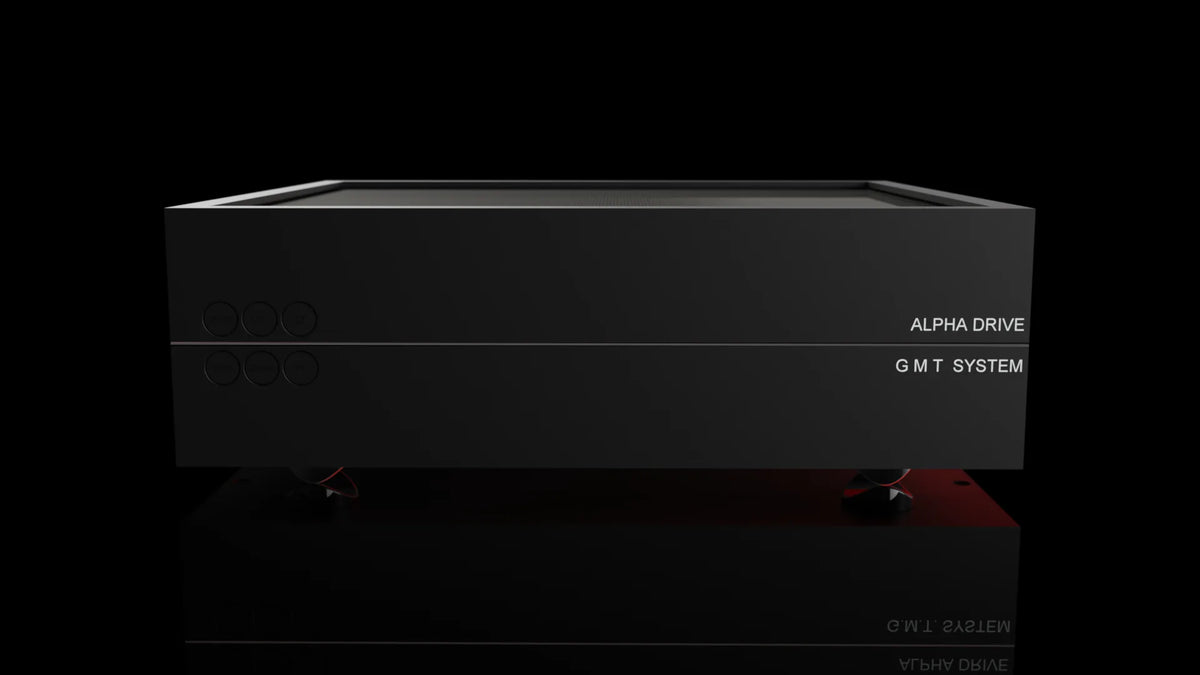
Twenty-seven novel developments in one unified analog platform. A 15-inch circumjacent radial force motor (the largest ever built for a turntable), quartz-referenced triple class-A amplification, and build-to-order manufacturing from Sheffield. Developed with the GMT Consortium and backed by Innovate UK funding.

GMT ONE System Turntable
The GMT ONE System is not a turntable in any conventional sense. It is a precision analog replay platform comprising twenty-seven novel developments, developed by the GMT Consortium with support from a £326,000 Innovate UK grant, and manufactured entirely in Sheffield. Every unit is built to order, every component bespoke.
OMEGA and ALPHA: Dual-Motor Architecture
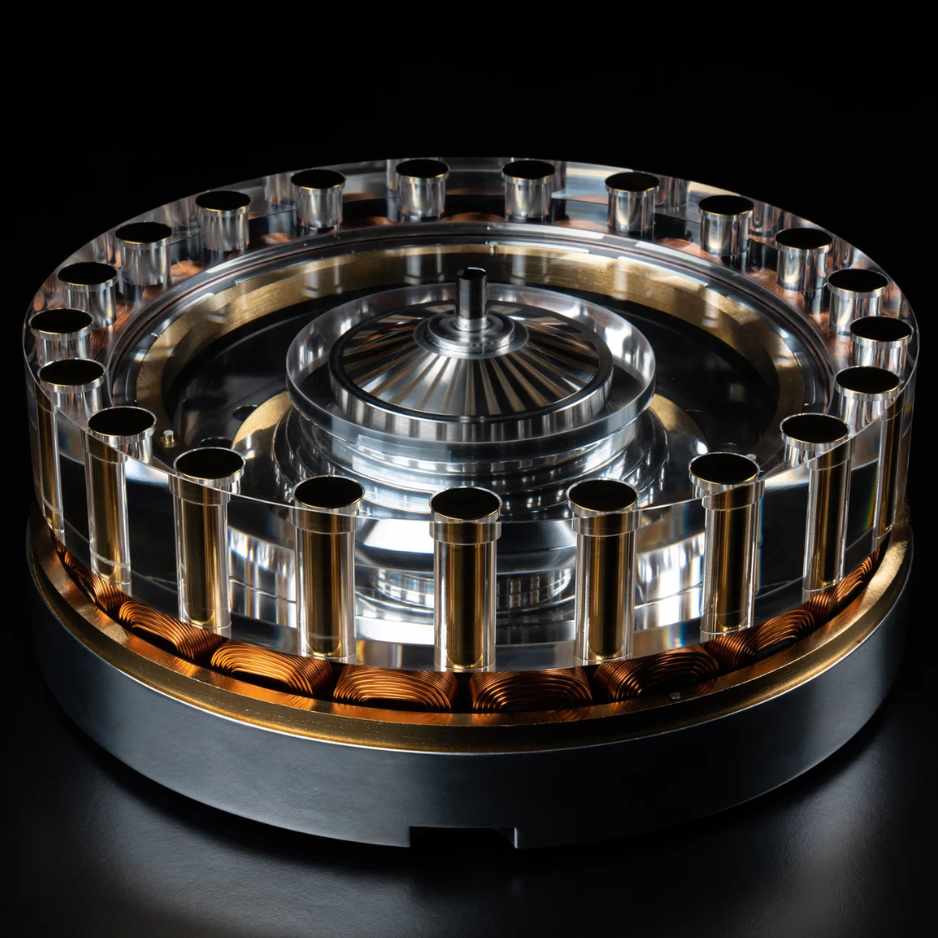
The OMEGA Drive is a 15-inch circumjacent radial force motor, the largest ever designed for a turntable. Its slot-less synchronous design produces zero cogging and zero torque ripple, with an RMS torque ripple value of just 0.001342 N.m. For context, the most commonly used direct-drive motor in turntable design today measures 3.07 inches, five times smaller. Professor Eric Laithwaite of the University of Manchester, inventor of the linear motor, derived an equation of "goodness" demonstrating that motor efficiency increases with size. The OMEGA Drive takes that principle to its physical conclusion.
The motor was developed by a team of doctors, professors, and engineers formed under the GMT Consortium in 2019. Dr. Faris Al-Naemi, Dr. Jon Travis, and Professor Cockerham of Sheffield Hallam University worked alongside Dr. Carl Broomfield and Neil Broomfield of CAAS Audio. Wilson Benesch invested in coil winding machinery and recruited a graduate engineer to work exclusively on defining coil geometry through precision mandrels. The stator governs synchronicity with such accuracy that once the rotor is locked in, the system requires no feedback or complex speed compensation.
The ALPHA Drive delivers power to those 21 magnetic poles through three discrete linear class-A amplifiers, each producing a low-distortion 1.2-amp sine wave governed by an onboard 11.2896 MHz quartz crystal. One phase feeds seven poles in a 7-by-7-by-7 formation. A novel startup algorithm from the onboard microprocessor overcomes the significant air gap between stator and rotor, accelerating the platter to synchronicity. Hall sensors monitor speed and prevent the Piezo VTA system from engaging until precise rotation is confirmed.
Unified System Design
Most analog systems are assemblies of third-party components: a turntable from one manufacturer, a tonearm from another, a cartridge from a third. The GMT ONE eliminates the pitfalls of that approach by treating turntable, tonearm, phono stage, and cartridge as interdependent parts of a single whole. This philosophy first appeared in the Wilson Benesch Total System of 1996, but the GMT ONE takes it further with twenty-seven completely novel developments across every subsystem.
The magnetic counter-force design illustrates how deeply the integration runs. The OMEGA Drive motor weighs 14 kg. Following analysis led by Dr. Al-Naemi at Sheffield Hallam, two powerful N30H NdFeB magnets were incorporated to reduce dynamic mass at the Angstrom bearing contact point, keeping Hertzian forces well within tolerance. The platter, motor, bearing, and isolation system are not separate problems solved separately. They are one mechanical equation solved as a system.
Every GMT ONE is built to order. There is no stock shelf. The system can be specified with polished silver or polished gold accents across the Graviton Ti armwand, Tessellate Ti cartridge, platter weights, glass-top caps, and R1 Rack metal components. Total system weight: 369.5 kg (523 lbs).
GMT Control App
The GMT ONE ships with a dedicated smart device pre-installed with the WB GMT Control App and a preconfigured router that connects exclusively to the system. No internet connection, no cloud dependency, just a direct link between the user and their turntable from the listening position.
Speed adjustment operates in 0.01 RPM increments across 33.3, 45, and 78 RPM formats. The Piezo VTA system is controllable in 1-nanometer steps. Start/stop and lift/lower for the Graviton Ti tonearm are handled remotely. Wow and flutter: not measurable. This is not a convenience feature bolted onto a turntable. It is a control interface designed from the ground up as part of the system, giving users access to the precision that the hardware actually delivers.
Somehow this system brings out the best from every musical genre. It rocks with the greatest grit and authority, swings mightily, and delivers the concert hall's acoustic space and the orchestra's timbral and textural verisimilitude better than any turntable I've so far heard. The years of R&D that went into this project have surely paid off.
- Michael Fremer, The Absolute Sound, Golden Ear Award
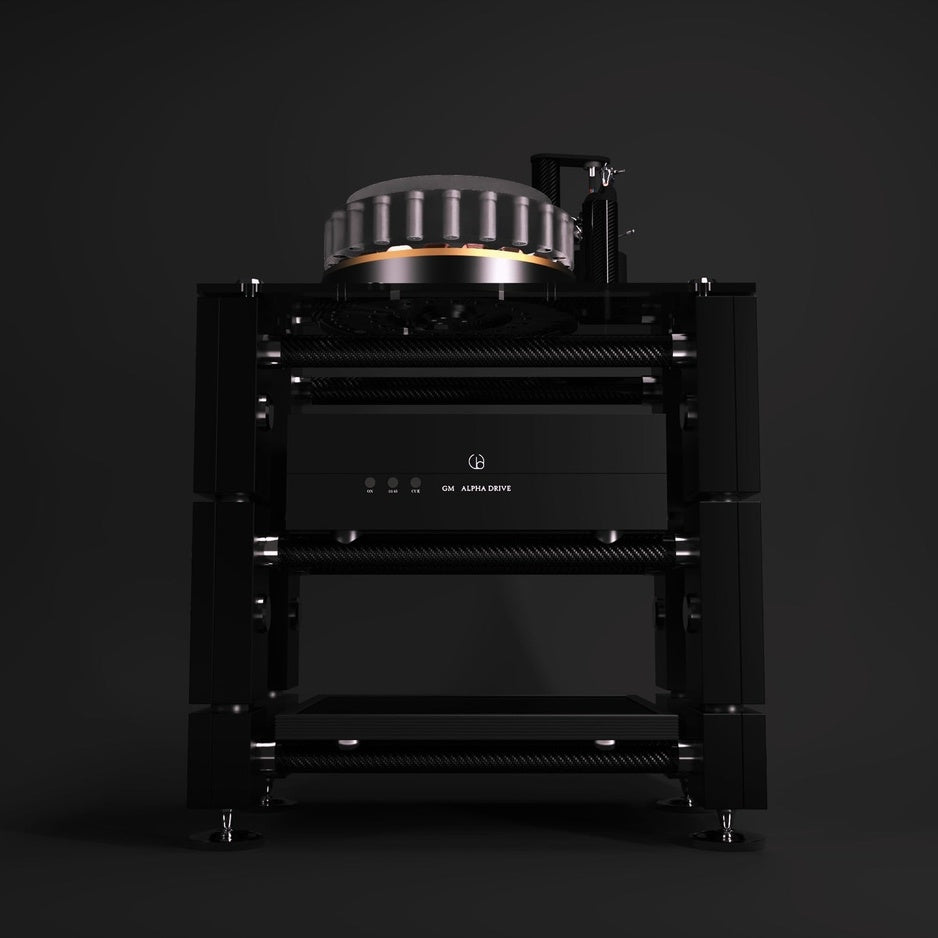
Greenwich: The GMT Platform Entry Point
The Greenwich shares the same 15-inch OMEGA motor and ALPHA drive electronics as the GMT One. What changes between tiers is isolation and signal architecture, not the engine. At 64kg, it delivers the full ALPHA-OMEGA direct drive experience in a more focused package.

Greenwich: The GMT Platform Entry Point
The Greenwich answers the question Wilson Benesch heard most after launching the GMT One: what if you want the engine without the full system? Same 15-inch OMEGA motor. Same ALPHA drive electronics with quartz-referenced class-A amplification. Same zero-cogging, zero-ripple direct drive architecture developed by the GMT Consortium. What changes as you move up the GMT hierarchy is isolation and signal architecture, not the engine.
Same Drive, Different Chassis
The ALPHA-OMEGA drive platform is identical across the GMT range. The Greenwich runs the same 15-inch circumjacent radial force motor, the same 21 magnetic poles, the same triple class-A amplifier array governed by the same 11.2896 MHz quartz crystal. The motor does not know which turntable it sits in. The stator-rotor relationship that produces zero cogging and zero torque ripple on the GMT One produces exactly the same result on the Greenwich.
Where the turntables diverge is in everything surrounding that motor. The Greenwich uses a tuned spring damping system for isolation, effective and well-matched to the platform but different from the LeVeL pneumatic system derived from electron microscopy on the GMT One. The Piezo VTA system is available as an upgrade rather than included. The STAGE One signal path is integrated into the armhub with the connection type fixed at the time of order, rather than offering the modular signal architecture of the higher-tier models.
Who the Greenwich Is For
The buyer who has heard what the ALPHA-OMEGA drive does to a vinyl groove and wants that specific sound. Not a compromise turntable. Not a stripped-down version of something better. The same precision motor platform in a package that trades the GMT One's elaborate isolation and signal flexibility for a more direct, focused approach. It sits below the Prime Meridian and GMT One in the range, but shares the technology that earned The Absolute Sound's Turntable of the Year award.
Every Greenwich is built to order at Falcon House in Sheffield with a lead time of 12-14 weeks. Available with the full range of finish options across the Graviton Ti armwand and system accents.
LeVeL: Pneumatic Isolation from Electron Microscopy
Four microprocessor-controlled pneumatic rams adapted from Thorlabs optomechanical isolation systems, achieving a 1.7 Hz resonant frequency. Fully autonomous, no user adjustment required. A medical-grade oil-free air compressor can be installed in a separate room.

LeVeL: Pneumatic Isolation from Electron Microscopy
A turntable is a precision measurement instrument. Any vibration from the floor, the room, or the equipment rack that reaches the stylus becomes part of the signal, amplified thousands of times by the phono stage. The LeVeL Isolation System addresses this at the microscopic level, providing an energy barrier between the listening room and the most sensitive components of the GMT ONE.
Wilson Benesch developed the LeVeL system in collaboration with Thorlabs, a manufacturer of optomechanical isolation systems used in electron microscopy, laser optics, and laboratory environments where nanometer-scale imaging demands absolute mechanical stillness. The same isolation principles that keep an electron microscope stable enough to image individual atoms now keep the GMT ONE platter stable enough to trace a vinyl groove without contamination from room energy.
Four microprocessor-controlled pneumatic rams continuously monitor the platform and adjust in real time, maintaining stability even when external disturbances occur. The system achieves a resonant frequency of 1.7 Hz, well below the audible band and well below any typical floor or room resonance. At that frequency, the isolation platform simply does not participate in the acoustic life of the room.
The plinth itself is precision-machined to an inverted pyramid form, calculated to offset the off-axis mass of the OMEGA Drive motor, Graviton Ti armwand, Piezo VTA system, and STAGE One phono stage. Equal mass distribution at all four supporting points is critical for the Thorlabs system to operate at its specified performance. Wilson Benesch designed the geometry so the centre of gravity falls exactly where it needs to, with no user adjustment required.
A medical-grade, oil-free air compressor powers the pneumatic system. It operates only when a significant disturbance occurs and can be installed in a separate room away from the listening environment. The entire LeVeL system is fully autonomous: once installed, it requires zero setup, zero calibration, and zero maintenance from the user. It simply works, continuously, providing the mechanical foundation that allows every other GMT ONE technology to perform at its full capability.
Graviton Ti Tonearm
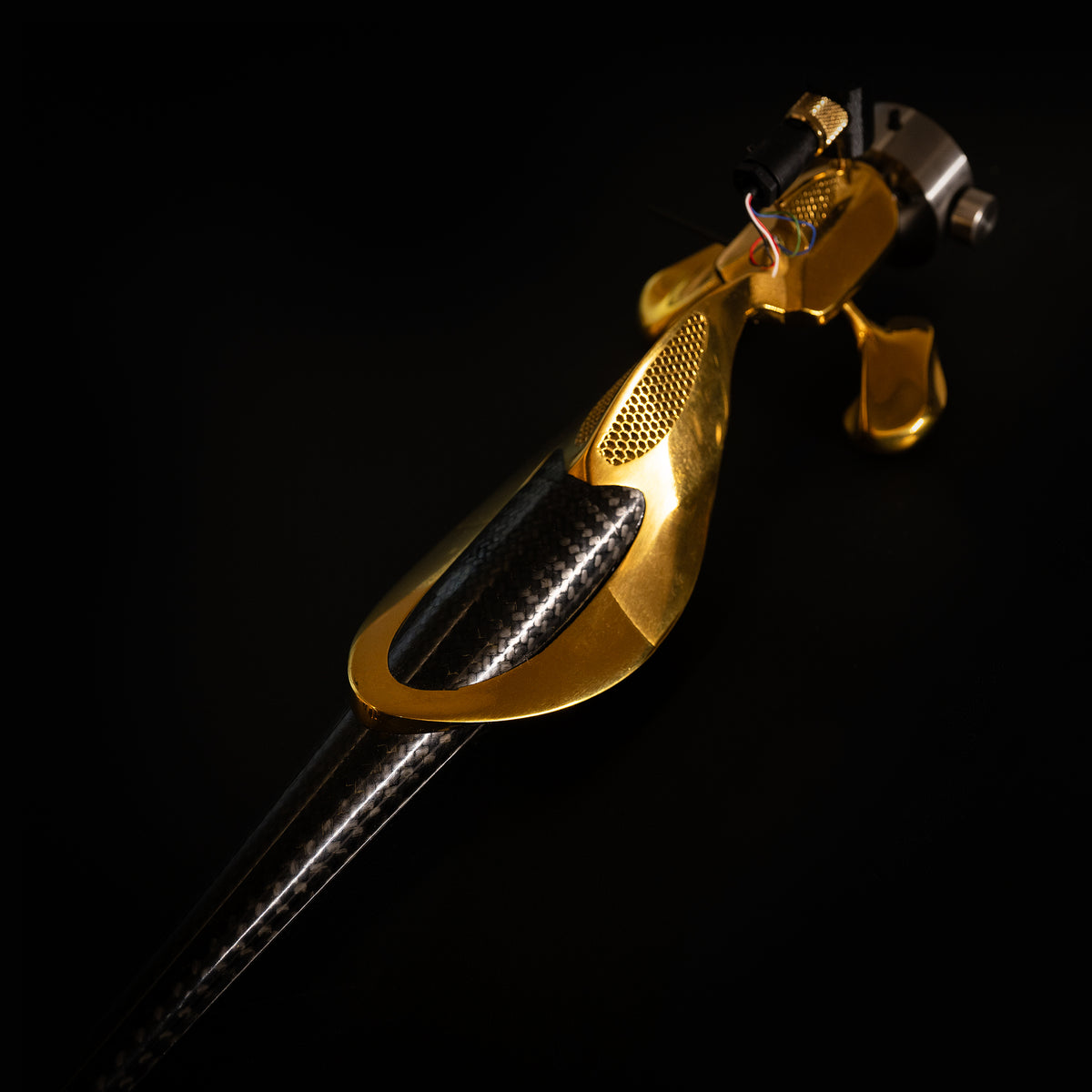
A quadruple-helix carbon fiber armtube hand-laid in Sheffield, with SLS titanium counterbalance grown in collaboration with the AMRC and Renishaw. Under 1,232 psi max stress, deflection of just 0.003mm. A single continuous energy pathway from headshell to counterweight, with no bolt-on joints.

Graviton Ti Tonearm
The Graviton Ti represents over three decades of Wilson Benesch research in composites, additive manufacturing, and precision engineering. It is the first high-end tonearm to unite a hand-laid graphene-reinforced carbon fiber armtube with 3D-printed titanium structures, an innovation born from collaborations with the AMRC, Renishaw PLC, and the FEMTO Institute in France.
Quadruple Helix Carbon Fibre Armtube
The armtube is hand-laid in Sheffield using Wilson Benesch's proprietary Vacuum Resin Transfer Moulding (VRTM) system. This is not a repurposed pre-preg tube from an OEM composites supplier. Each carbon fiber ply is cut by hand and positioned in a quadruple helical pattern, wrapping around the armtube in four distinct spirals. A graphene-reinforced epoxy matrix binds the structure, with unidirectional carbon fiber and a Rohacell sandwich section adding further rigidity.
The result is a single-piece construction that includes the integrated headshell, with no bolt-on joints and therefore no reflective boundaries where vibrational energy can bounce back toward the stylus. Data from Sheffield Hallam University demonstrates the armtube's exceptional rigidity: under a maximum stress of 1,232 psi, deflection measures just 0.003mm. Research conducted with the FEMTO Institute during the SSUCHY grant project confirmed that the hyperbolic taper geometry Wilson Benesch selected in 1989 for the original A.C.T. One Tonearm was close to optimal, providing zero redundancy of materials while maximizing torsional stiffness through the helical fiber orientation.
SLS Titanium Counterbalance
The counterbalance structures are grown layer by layer via Selective Laser Sintering, developed in collaboration with the AMRC at the University of Sheffield, Renishaw PLC, and four graduate engineers with diverse disciplines. The titanium geometries follow the helical pathways of the carbon fiber layup, creating a large, precisely matched surface-area interface between the two materials. Vibrational energy moves smoothly from carbon into titanium without abrupt reflection points.
The internal geometry draws directly from natural structures. Trabecular bone distributes density where load-bearing demands it most. The Graviton Ti counterbalance applies the same principle: tessellated lattice sections provide maximum stiffness, hollow sections reduce mass where it is not structurally needed, and sections of intentionally un-sintered titanium powder act as internal "sandbags" that absorb vibrational energy. The visible lattice at the top of the counterbalance hints at the complexity hidden under the solid titanium skin throughout the rest of the structure. These forms could not have been achieved through any other means of production. They are now registered designs.
Zirconium Kinematic Bearing
Building on the kinematic bearing first introduced in the A.C.T. One Tonearm in 1989, the Graviton Ti advances the concept with zirconium elements polished to extreme tolerances. Three 1mm balls form a hybrid configuration: two zirconium balls and one damping-enhanced conductive ball. The result is ultra-low friction with defined Hertzian contact zones, zero stiction, and a bearing that combines the frictionless agility of a unipivot with the stability of a gimbal while surpassing both.
Where conventional unipivot bearings trade stability for low friction, and gimbal bearings introduce stiction through multiple ball-race assemblies, the kinematic approach fixes the pivot in an exact, unchanging position with infinitesimal contact points. Energy is channeled away from the stylus into defined dissipation pathways through the counterbalance structure.
EcoGrip Hydraulic Chuck
The EcoGrip is borrowed from industrial machining. Hydraulic actuation expands uniformly around the VTA shaft, wrapping the chuck evenly with zero point loading. A graphite-lubricated interface provides friction-free travel during setup. Locking the chuck introduces no deformation whatsoever, keeping the bearing pivot in perfect alignment. This manufacturing-grade precision is what makes the nanometric accuracy of the Piezo VTA system physically possible. Without a clamping system this precise, 1-nanometer adjustments would be meaningless.

Piezo VTA: Nanometre-Precision Setup
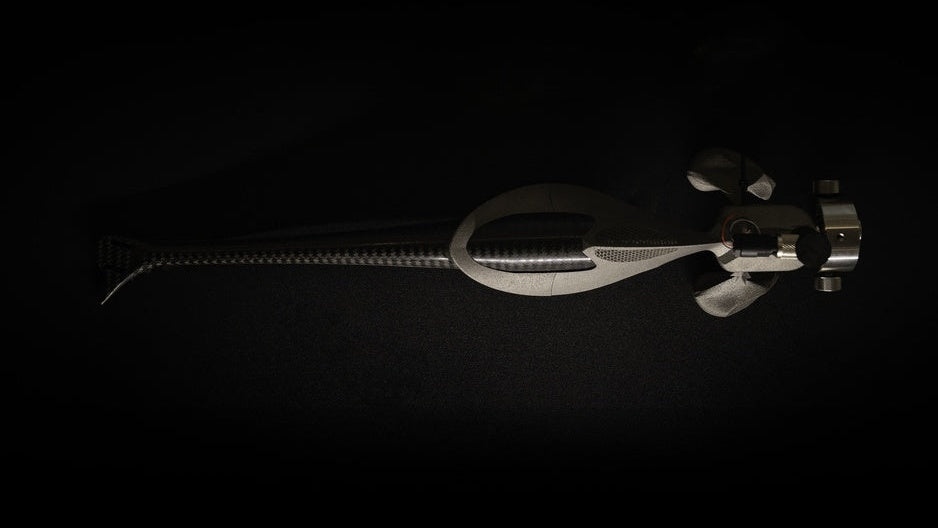
A piezo actuator borrowed from telescope star-tracking delivers VTA adjustment in 1-nanometer repeatable steps, where a human hair measures 80,000 nanometers across. The GMT Control App displays position numerically for memorized per-record settings. Available on GMT ONE and Prime Meridian turntables.

Piezo VTA: Nanometre-Precision Setup
Vertical Tracking Angle (VTA), or stylus rake angle, determines how the stylus contacts the groove walls. Get it wrong and you lose information, increase distortion, and accelerate record wear. Get it right and the cartridge extracts maximum musical detail with minimum groove damage. The difference between correct and incorrect VTA is measured in microns, which is why conventional adjustment methods have always been the weakest link in analog setup.
Conventional tonearms use M3-threaded adjusters to set VTA. These threaded systems have inherent problems: coarse tolerances, backlash between threads, and mechanical play that means the arm never quite returns to the same position twice. The adjustment is manual, tactile, and approximate. Users tighten a grub screw, listen, loosen it, try again. It is the 19th-century approach to a problem that demands 21st-century precision.
The Graviton Ti replaces the threaded adjuster with a linear piezo actuator, the same technology used in telescopes to track distant stars with nanometer accuracy. In astronomical applications, even the smallest mechanical error compounds over vast distances. The precision requirements are absolute. Wilson Benesch applied that same standard to VTA control.
The piezo system delivers adjustments in repeatable increments of 1 nanometer. A human hair measures 80,000 to 100,000 nanometers across. This is not a specification chosen for marketing impact. It is the natural resolution of piezo actuation, and it means VTA can be set with a degree of accuracy that threaded systems cannot approach by orders of magnitude.
The EcoGrip hydraulic chuck makes this precision physically meaningful. Because the chuck conforms uniformly to the VTA shaft with zero deformation on locking, the nanometric adjustment survives the clamping process. A coarse clamp would negate the piezo's resolution before the stylus ever touched the groove.
The GMT Control App displays VTA position numerically, allowing users to store settings for individual records and return to them with perfect repeatability. Adjust VTA from the listening position in real time, hear the difference, save the number. No more crawling to the turntable with an Allen key between tracks. The Piezo VTA system is available exclusively on the GMT ONE and Prime Meridian turntables.
STAGE One: Pure Signal Architecture
An over-arm step-up transformer positioned directly above the tonearm pivot, with less than one inch of unshielded cable. Eliminates the torsional forces that conventional cable loops exert on the bearing, while providing copper-shielded EMI protection for the cartridge's 0.2-0.5 millivolt signal.

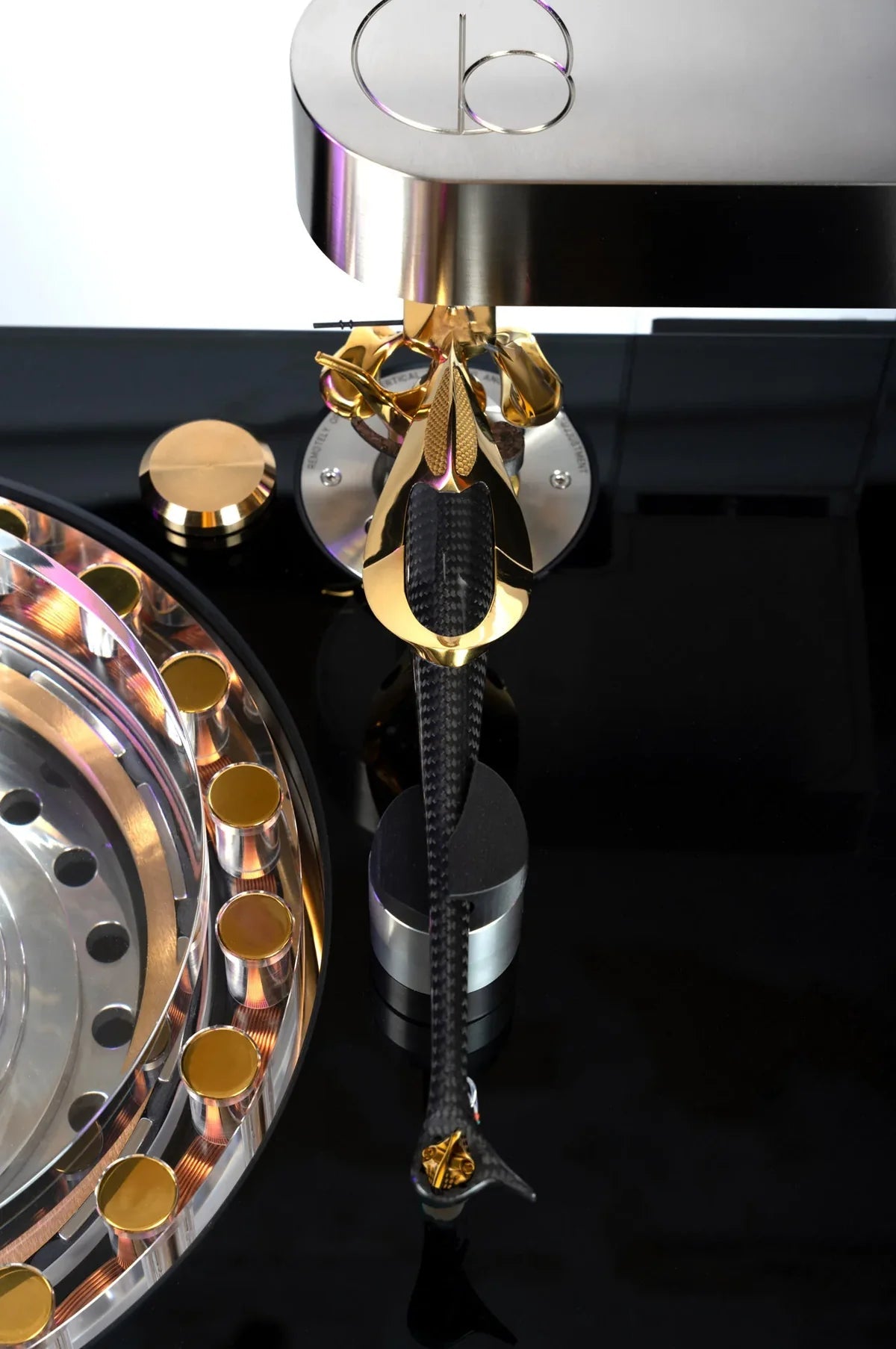
STAGE One: Pure Signal Architecture
A moving-coil cartridge generates a signal of 0.2 to 0.5 millivolts. The phono preamplifier amplifies that signal by a factor of more than 1,000 to reach line level, and the power amplifier multiplies it again to drive the loudspeakers. Any distortion, interference, or mechanical stress introduced at the cartridge end of this chain is amplified thousands of times before it reaches the listener. The STAGE One exists to protect the signal at its most vulnerable point.
In conventional tonearms, the cable exits behind the pivot in a loop. That loop has mechanical memory: it acts like a torsion spring, constantly pushing and pulling against the bearing. The force is small, but it is continuous, and it biases the tonearm's motion in ways that compromise stylus tracking. Every tonearm designer knows this problem exists. Most accept it as a necessary compromise.
The STAGE One eliminates it. The tonearm wire routes vertically, exiting directly above the pivot point through the "over-arm" design. In this orientation, no torsional forces are transmitted to the bearing assembly. The tonearm sits in a state of pure mechanical neutrality, free from the reactive stresses that a trailing cable loop introduces. The bearing can do what it was designed to do: allow the stylus to follow the groove with zero interference from the signal path itself.
The electrical architecture is equally deliberate. From the carbon fiber armtube, the tonearm wire transitions into a compact copper-shielded STAGE One enclosure with less than one inch of unshielded cable exposed. This creates an EMI-resistant chamber at the most vulnerable point in the entire replay chain. The cartridge signal at this stage is measured in fractions of a millivolt. Environmental electromagnetic interference that a line-level signal would shrug off can corrupt a cartridge signal irreversibly, and that corruption gets amplified more than a thousandfold before anyone hears it.
The STAGE One is not an accessory or an aftermarket upgrade. It is an integral component of the GMT system's unified design philosophy, where turntable, tonearm, phono stage, and cartridge are treated as one mechanically and electrically coherent system. By combining mechanical decoupling, torsion-free cable routing, and copper EMI shielding into a single structure positioned at the critical junction between cartridge and amplification, the STAGE One ensures that the signal arriving at the phono preamplifier is as close to what the stylus actually traced as the laws of physics allow.
Tessellate Ti Cartridges
The first phono cartridge with an SLS titanium body. Tessellated lattice sidewalls, U-section geometry achieving the stiffness of an 18mm solid at under 30% of the mass, and a five-material energy management interface. Heritage traces to Wilson Benesch's 1992 world-first carbon fiber cartridge.

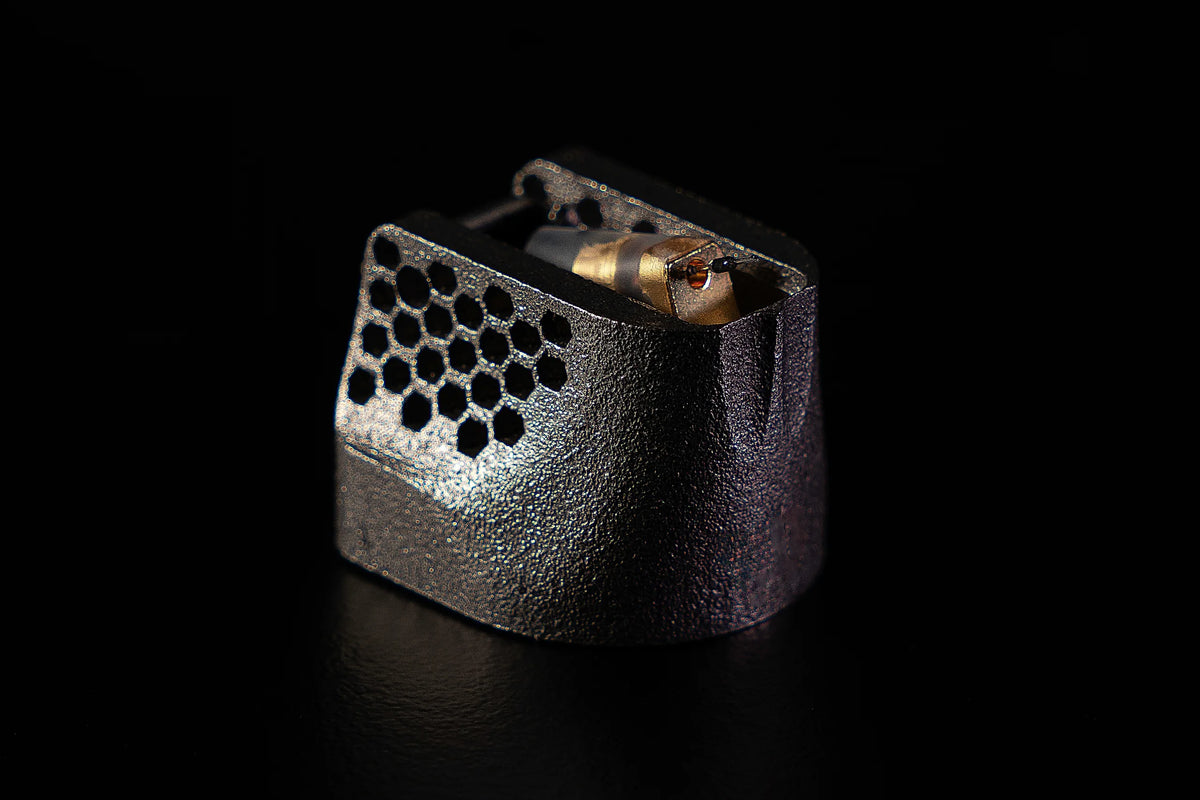
Tessellate Ti Cartridges
Wilson Benesch introduced the world's first carbon fiber cartridge body in 1992. Thirty years of research into how geometry and material selection govern resonance behavior led to the Tessellate Ti, which replaces carbon fiber with additively manufactured titanium and applies every lesson learned along the way.
Heritage: World's First Carbon Fibre Cartridge
In 1992, Wilson Benesch collaborated with Benz Micro to produce three cartridges that tested a single hypothesis: how does body geometry affect resonance? The Carbon featured a flat-sided carbon fiber shell that reflected vibrational energy back into the generator, introducing audible coloration. The Analogue adopted a curved shell geometry, which reduced those reflections and improved resolution. The Ply used an entirely open-body design that virtually eliminated shell reflections but introduced a different acoustic signature from its exposed structure.
These were not three products competing for market share. They were three experiments that proved the same point: the geometry, material selection, and interface design of the cartridge body directly govern its resonance behavior and, by extension, its musical performance. Every design decision in the Tessellate Ti traces back to data gathered from those 1990s prototypes.
Tessellated Titanium Body
The Tessellate Ti body is built using Selective Laser Sintering, developed in collaboration with Renishaw PLC and the University of Sheffield. Multiple high-power lasers fuse titanium particles layer by layer in an inert gas atmosphere, creating a seamless single-piece structure with zero material redundancy. The visible tessellated lattice sidewalls dramatically reduce mass while increasing stiffness, functioning as energy diffusers that eliminate flat reflective surfaces. The U-section geometry, clearly visible in rear profile, achieves the stiffness of an 18mm solid structure using less than 30% of the mass.
The semi-open architecture is a direct application of the 1992 findings. Where the Ply cartridge demonstrated the acoustic benefits of an open body but lacked structural rigidity, the Tessellate Ti achieves both: maximum stiffness, minimum mass, maximum damping, and minimal reflective surfaces through the tessellated lattice. Asymmetric curvature in the headshell region avoids symmetry-based standing waves and promotes chaotic dispersion of vibrational energy. This is the highest specific stiffness ever measured in any cartridge, including the carbon fiber designs that preceded it.
The FIN and Multi-Material Interface
Conventional cartridges are bolted to headshells with Allen bolts against a nominally flat surface. In practice, those surfaces are never perfectly flat, and contact occurs at only a few microscopic points, creating an unpredictable energy transfer path. The Tessellate Ti replaces this with an interference fit and a five-layer energy management system.
The tessellated honeycomb interface on the cartridge body works with a thin layer of viscoelastic adhesive. When the cartridge is torqued into position, the adhesive flows into the hexagonal lattice, forming precisely shaped polymer cushions that maximize contact surface area and damp vibrational energy at its source. The complete five-layer pathway: (1) tessellated titanium cartridge body, (2) viscoelastic adhesive filling the lattice, (3) carbon fiber headshell with helical fiber orientation, (4) cork energy-damping gasket with near-zero Poisson's ratio, and (5) the FIN, a 4-gram tessellated titanium arch manufactured via SLS whose broad base distributes clamping forces evenly across the interface.
Cork is the unsung component. Its closed-cell structure of millions of gas-filled pockets provides exceptional energy absorption. Its near-zero Poisson's ratio means it compresses without expanding laterally, maintaining a stable footprint under load. Wilson Benesch's understanding of cork's acoustic behavior was deepened during the EU-funded SSUCHY project, where bio-inspired structures informed material applications across the GMT system.
Hybrid Cantilever
Three cantilever variants serve different system requirements. The Ti-B uses boron, the Ti-S uses sapphire, and the Ti-D uses diamond. Each offers a different balance of stiffness, mass, and compliance, affecting tonal character and tracking precision at high frequencies where groove velocity changes create enormous accelerations.
All three share a world-first hybrid cantilever design. A unidirectional carbon fiber damping ring is bonded asymmetrically around the cantilever, adding virtually no mass while introducing significant damping. Vibrational energy traveling along the cantilever is dispersed through the carbon fiber at extremely high speed, suppressed before it can feed back into the generator. The asymmetric placement is deliberate: it provides both additional stiffness and damping in a single element. The Absolute Sound named the Ti-D Phono Cartridge of the Year in 2026.
The proof is in the listening and based upon that—and I've had more than four months with it—I must conclude that the system, the combination of the Tessellate cartridge and the turntable produced the best sound I've heard from vinyl records of every musical genre.
- Michael Fremer, The Absolute Sound
What to Pair With Wilson Benesch
Wilson Benesch speakers work well with a wide range of amplification, from low-power valve amps to high-current solid state. Luke Sherwood favors hybrid designs. Mike Hoatson demos the Omniums with Audia Flight FLS 8 monoblocks at The Listening Room.
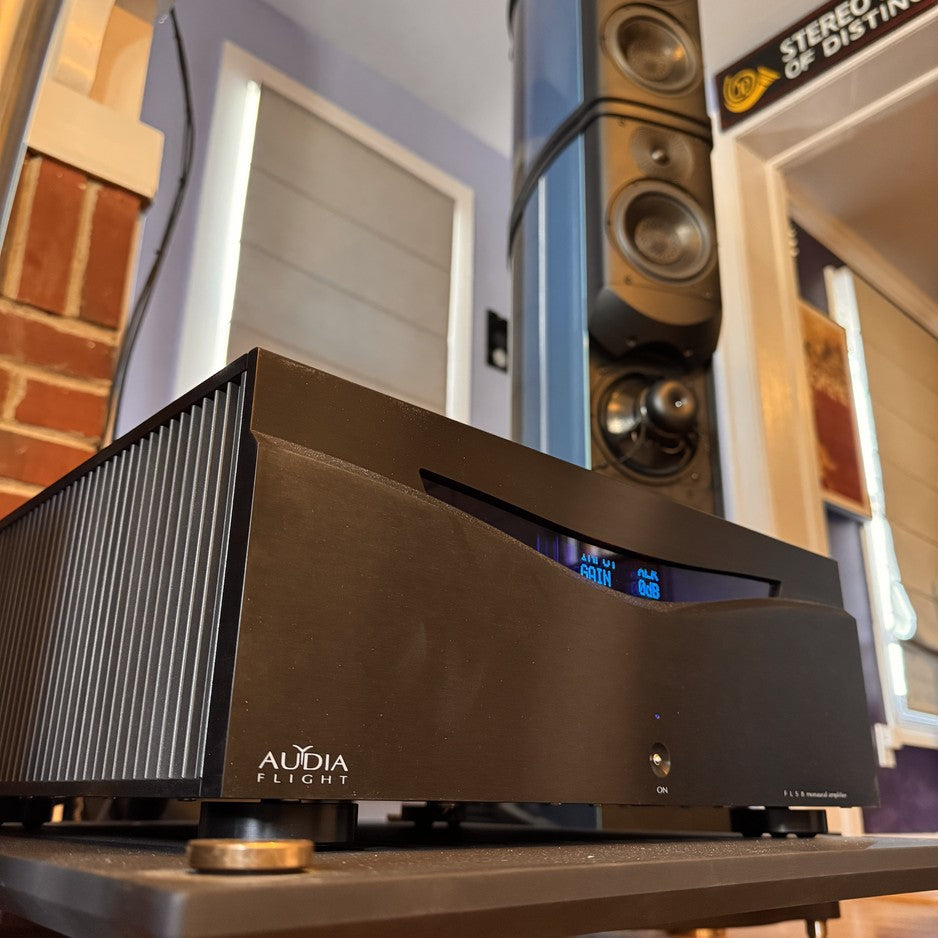
Wilson Benesch speakers are deliberately non-prescriptive about amplification. Luke Sherwood's own preference leans toward hybrid amplifiers that combine a tube output stage with solid-state input. The reasoning is practical: tubes add a natural warmth and harmonic richness to the signal, while solid state provides the current delivery and control that Wilson Benesch's isobaric bass systems need to perform at their best.
The result, as Luke describes it, has an "almost percussive quality to the bass, really immediate, like a stop-start sensation" that fully exploits the speed advantage of the isobaric design. Hybrid amplification gives you both the musicality of tubes and the grip of transistors.
Jazz listeners running low-power valve amplifiers find Wilson Benesch speakers particularly rewarding. The zero-coloration philosophy means the speaker adds nothing of its own character to the signal, letting the tonal nuances of valve amplification come through unaltered. A 30-watt triode amp driving a pair of Endeavors in a medium room can be a revelatory experience.
At the other end of the spectrum, high-current solid-state amplifiers like those from CH Precision, Karan Acoustics, or Audia Flight bring out the dynamic capabilities of larger Fibonacci models. At The Listening Room, Mike Hoatson demos the Omniums with Audia Flight FLS 8 monoblocks, a pairing that delivers massive scale with the kind of bass control that only high-current amplification can provide.
The consistent thread across all pairings: Wilson Benesch speakers respond honestly to whatever you feed them. Better amplification yields better results, but they never punish you for the equipment upstream. Their consistent 6-ohm nominal impedance and high-80s sensitivity make them straightforward to drive regardless of amplifier topology.
There's an almost percussive quality to the bass, really immediate, like a stop-start sensation. That's what you get from the isobaric system combined with the right amplification. The speed is there in the design. You just need to let it breathe.
- Luke Sherwood, Sales & Marketing Director
Awards & Recognition
Product of the Year 2020 & 2021
Eminence
Robert HarleyThe Absolute SoundGolden Ear Award
Eminence
2019The Audiobeat“A Genuine Breakthrough”
Eminence
Roy GregoryFIDELITY InternationalFeatured Review
Eminence
Carsten BarnbeckThe Absolute SoundTurntable of the Year
GMT ONE System
2025The Absolute SoundGolden Ear Award
GMT ONE System
2024The Absolute SoundPhono Cartridge of the Year
Tessellate Ti-D
2026What Hi-Fi?5-Star Rating
A.C.T. 3Zero
2023What Hi-Fi?5-Star Rating
Discovery 3Zero
2023The Absolute SoundGolden Ear Award
Resolution
2018The Absolute SoundEditors' Choice
Eminence
OngoingGolden Prestige Trophy
Omnium
2024Highlight Award
Resolution 3Zero
2023Product of the Year
Torus Infrasonic Generator
2008Queen's Award for Enterprise
Innovation in Advanced Manufacturing
Sheffield, UKProduct of the Year 2020 & 2021
Eminence
Robert HarleyThe Absolute SoundGolden Ear Award
Eminence
2019The Audiobeat“A Genuine Breakthrough”
Eminence
Roy GregoryFIDELITY InternationalFeatured Review
Eminence
Carsten BarnbeckThe Absolute SoundTurntable of the Year
GMT ONE System
2025The Absolute SoundGolden Ear Award
GMT ONE System
2024The Absolute SoundPhono Cartridge of the Year
Tessellate Ti-D
2026What Hi-Fi?5-Star Rating
A.C.T. 3Zero
2023What Hi-Fi?5-Star Rating
Discovery 3Zero
2023The Absolute SoundGolden Ear Award
Resolution
2018The Absolute SoundEditors' Choice
Eminence
OngoingGolden Prestige Trophy
Omnium
2024Highlight Award
Resolution 3Zero
2023Product of the Year
Torus Infrasonic Generator
2008Queen's Award for Enterprise
Innovation in Advanced Manufacturing
Sheffield, UKThe Wilson Benesch Lineup at TLR
The Listening Room carries the full Wilson Benesch Fibonacci series and select analog products. Every model in the range shares the same core technologies: carbon fiber composite monocoque enclosures, Tactic drive units with isotactic polypropylene cones, and the Fibonacci silk-carbon hybrid tweeter. The differences between models are primarily scale, driver count, and bass extension. Pricing below reflects base configurations; wood and paint finishes add to the cost.

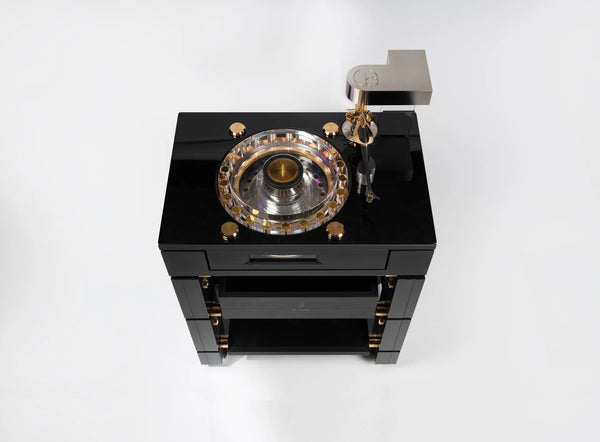
Fibonacci Series Speakers
Carbon fiber monocoque enclosures, isobaric bass, Fibonacci silk-carbon tweeters
At a Glance
| Model | Type | Key Technology | Starting Price |
|---|---|---|---|
| Eminence | Floorstanding | 9 drivers, dual isobaric bass | $249,999 |
| Omnium | Floorstanding | Full-scale Fibonacci with massive authority | $174,999 |
| Resolution 3Zero | Floorstanding | Extended Fibonacci with deep bass | $89,999 |
| Endeavor 3Zero | Floorstanding | Full-range with isobaric bass | $59,999 |
| A.C.T. 3Zero | Floorstanding | 6th gen, biocomposite monocoque + isobaric | $54,999 |
| Horizon | Floorstanding | Compact, 35Hz-30kHz, 89dB | $44,999 |
| Discovery 3Zero | Standmount | Isobaric bass in standmount form | $34,999 |
| IGX | Infrasonic Generator | 18" carbon fiber, dual push-pull magnets | $39,999 |


Wilson Benesch Discovery 3Zero Product Showcase

Analog Collection
Turntables, tonearms, and cartridges with 3D-printed titanium construction
At a Glance
| Model | Type | Key Feature | Starting Price |
|---|---|---|---|
| GMT ONE System | Turntable System | 30+ patents, dual-motor zero-backlash drive | Call For Price |
| Greenwich | Turntable | Same ALPHA-OMEGA drive, 15-inch motor | Call For Price |
| Graviton Ti Armwand | Tonearm | Single-billet titanium, piezo VTA control | $52,000 |
| Tessellate Ti-D | MC Cartridge | Diamond cantilever, titanium body | $18,500 |
| Tessellate Ti-S | MC Cartridge | Sapphire cantilever, titanium body | $12,000 |
| Tessellate Ti-B | MC Cartridge | Boron cantilever, titanium body | $7,500 |
Turntables
ALPHA-OMEGA direct drive platform, built to order in Sheffield


Tonearms
Graviton Ti armwand with 3D-printed titanium and nanometre VTA precision

Tessellate Ti Cartridges
3D-printed titanium bodies with diamond, sapphire, and boron cantilevers


Frequently Asked Questions
What amplifier do I need to drive Wilson Benesch speakers?
What amplifier do I need to drive Wilson Benesch speakers?
Wilson Benesch speakers are easier to drive than their price and technology might suggest. Most models maintain sensitivity in the high 80 dB range with a nominal impedance of 6 ohms. They do not dip into the 2-ohm territory common among high-end floorstanding speakers. A quality integrated or power amplifier delivering clean power will work well. Wilson Benesch recommends auditioning with your specific amplifier rather than relying on specifications alone, as room acoustics and listening preferences play a significant role. The Listening Room can help match amplification to your specific Wilson Benesch model and room.
Why does Wilson Benesch use carbon fiber composites instead of MDF?
Why does Wilson Benesch use carbon fiber composites instead of MDF?
MDF (medium-density fiberboard) requires internal bracing to achieve structural rigidity, adds wall thickness that reduces internal volume, and has limited ability to damp resonance once excited. Carbon fiber composites in a monocoque structure are inherently rigid without bracing, allow thinner walls (increasing usable internal volume), and when combined with damping layers in the composite sandwich, dissipate energy rather than storing and re-radiating it. The result is a cabinet that contributes far less coloration to the sound. Wilson Benesch has been engineering with carbon fiber composites since the early 1990s, well before it became a visual trend in the industry.
What is an isobaric drive system and why does Wilson Benesch use it?
What is an isobaric drive system and why does Wilson Benesch use it?
An isobaric drive system couples two matched drivers together to act as a single unit with two motors. This produces the bass output of a driver twice its size from a physically compact assembly. Wilson Benesch uses this approach throughout the Fibonacci series because it allows them to build speakers with deep, powerful bass in compact enclosures that are easier to control acoustically and integrate into a room. The dual-motor configuration also provides excellent transient response, meaning bass notes start and stop cleanly rather than lingering or blooming.
Do Wilson Benesch speakers need a large room?
Do Wilson Benesch speakers need a large room?
Wilson Benesch does not prescribe minimum room sizes. Their compact enclosure philosophy (enabled by isobaric bass and carbon fiber construction) means that even the larger models have smaller footprints than competing speakers with similar bass extension. The Discovery 3Zero standmount works well in smaller rooms. The Horizon and A.C.T. 3Zero suit medium rooms. The larger models (Resolution, Endeavor, Eminence) benefit from more space but remain manageable because their enclosures are slim and their bass is tight rather than boomy. Contact The Listening Room if you would like guidance on which model fits your space.
What is the Fibonacci tweeter and how is it different from a standard silk dome?
What is the Fibonacci tweeter and how is it different from a standard silk dome?
The Fibonacci tweeter starts with a silk dome, prized for its smooth, non-fatiguing sound. Wilson Benesch hand-applies a tow of carbon fiber in a halo pattern across the dome's crown, reinforcing the weakest point where standard silk domes begin to break up around 18-20 kHz. This carbon fiber structure pushes the breakup frequency beyond 30 kHz, adding only 0.01 grams. The result is the smoothness of silk with the extended bandwidth to faithfully reproduce high-resolution audio formats, all without the ringing and sibilance associated with metal dome tweeters.
Are Wilson Benesch speakers worth the investment?
Are Wilson Benesch speakers worth the investment?
Wilson Benesch does not start with a target price and work backward. They start with the most advanced materials and engineering they can access, design the finest product possible, and then assign a price. Every component is designed and built in-house at their Sheffield facility, from the drive units and tweeters to the monocoque enclosures and 3D-printed titanium parts. There is no off-the-shelf content. The investment reflects bespoke engineering, vertically integrated manufacturing, and materials science that most audio companies cannot replicate. These speakers are built to last decades, and their resale values reflect the market's respect for the engineering.
Does Wilson Benesch offer a break-in period recommendation?
Does Wilson Benesch offer a break-in period recommendation?
Wilson Benesch acknowledges that their speakers improve with use. The cabinet settles into its environment, the drivers bed in physically, and performance improves as components adjust to the climate and humidity of the listening room. This process happens naturally over the first several weeks of regular listening. The Listening Room includes white-glove delivery and setup for all Wilson Benesch speakers, which ensures optimal initial placement and allows Mike to dial in the system from the start.
Where are Wilson Benesch speakers made?
Where are Wilson Benesch speakers made?
Every Wilson Benesch product is designed and manufactured at the company's facility in Sheffield, England. Sheffield has a long history in materials science and advanced manufacturing, home to the AMRC (Advanced Manufacturing Research Centre) where Boeing, Rolls-Royce, and McLaren also operate. Wilson Benesch collaborates with these institutions and the University of Leeds. The company is vertically integrated: raw materials enter the facility and finished products leave. All drive units, tweeters, enclosures, crossovers, and 3D-printed components are built in-house by hand.
What is the IGX and how is it different from a regular subwoofer?
What is the IGX and how is it different from a regular subwoofer?
The IGX (Infrasonic Generator) uses an 18-inch carbon fiber diaphragm with a dual push-pull magnet structure in a vertically oriented drum-shaped enclosure. Unlike conventional subwoofers that prioritize raw output, the IGX prioritizes speed and integration. There is no traditional driver basket. The enclosure has no flat panels (drums are inherently stiff). The dual-motor design provides four-wheel-drive-like control over the diaphragm. The result integrates seamlessly with the fast, articulate bass of the Fibonacci speakers, extending response into infrasonic territory without introducing timing lag or bloom.
What is the Tactic 3.0 drive unit?
What is the Tactic 3.0 drive unit?
The Tactic 3.0 is Wilson Benesch's proprietary mid-bass and midrange driver, now in its third generation. It uses an isotactic polypropylene cone (co-developed with the University of Leeds) that avoids the complex breakup modes found in metal and carbon diaphragms. The 3.0 version adds the Fibonacci Element, a 3D-printed dust cap using five materials to fine-tune crossover integration. In most Fibonacci models, the midrange Tactic runs directly amplifier coupled with zero crossover components between the amplifier and the driver.
What is the GMT ONE System and what makes it different from other turntables?
What is the GMT ONE System and what makes it different from other turntables?
The GMT ONE System is Wilson Benesch's flagship analog replay platform, developed by the GMT Consortium with over thirty patented innovations. Its OMEGA and ALPHA dual-motor architecture provides zero-backlash, closed-loop speed control monitored in real time. The isolation system borrows pneumatic technology from electron microscopy. The companion GMT Control App allows precise RPM monitoring and piezo-driven VTA adjustment from a phone or tablet. Michael Fremer of The Absolute Sound awarded it a Golden Ear Award and named it Turntable of the Year.
What are the differences between the Tessellate Ti-B, Ti-S, and Ti-D cartridges?
What are the differences between the Tessellate Ti-B, Ti-S, and Ti-D cartridges?
All three Tessellate Ti cartridges share the same SLS titanium body, tessellated lattice sidewalls, interference fit mounting, and FIN titanium arch. The difference is the cantilever material. The Ti-B uses boron, the Ti-S uses sapphire, and the Ti-D uses diamond. Each offers a different balance of stiffness, mass, and compliance, affecting tonal character and tracking precision. All three include Wilson Benesch's world-first hybrid cantilever with a U.D. carbon fiber damping ring. The Ti-D was named Phono Cartridge of the Year by The Absolute Sound in 2026.
Experience Wilson Benesch at The Listening Room
Visit our showroom in Chestertown, Maryland to hear Wilson Benesch in person. White-glove delivery and setup included with every speaker and turntable purchase.
Shop Wilson Benesch